
Spring Sale Special - Limited Time 70% Discount Offer - Ends in 0d 00h 00m 00s - Coupon code: sntaclus

A department director has been asked to compare the productivity of the department with the productivity of similar departments at other facilities. Which of the following Is the first step of this project?

A.

Review department Job descriptions with another facility of similar size.

B.

Monitor the work flow in the department for at least six months.

C.

Conduct a search on the Internet for guidelines.

D.

Determine which processes will be evaluated,

A treatment center has experienced an increasing number of adverse medication safety events. Data review shows a medication error rate for drug–drug interactions of 15.7 per 1,000 medications dispensed. The organizational goal is less than 5 per 1,000, and ultimately zero. Which of the following solutions is most appropriate for the treatment center to consider?

A.

Human factors engineering

B.

Electronic medical record implementation

C.

Barcode medication administration

D.

Computerized provider order entry

Which of the following conclusions might be drawn from failure mode and effects analysis (FMEA)?

A.

Key factors were identified, and corrective action plans were created.

B.

Actions were taken to address baseline performance and monitored for sustainment.

C.

Risks were identified and prioritized, and action plans were developed.

D.

Special causes were identified, and variation was reduced.

Secondary prevention Is Primarily Intended to

A.

eliminate risk factors for a disease.

B.

prevent disease or disease process.

C.

focus on early detection and treatment of disease.

D.

reduce moderate disability associated with advanced disease.

A new urgent care clinic is setting up a quality management system. Which of the following is the bestchoice as a process measure to evaluate effective clinical care?

A.

percent of patients that rate care as "satisfactory" or "highly satisfactory"

B.

raw number of influenza vaccines given in the annual flu season

C.

percent of antibiotic prescriptions that meet evidence-based guidelines

D.

average wait time between check-in and seeing a provider

A physician complains about the time it takes to receive laboratory results. The chief of the laboratory states that response times are adequate. Which of the following actions should the quality manager do first?

A.

Revise the process to improve the timeliness of laboratory result reporting

B.

Facilitate a meeting between the chief of the laboratory and laboratory staff

C.

Ask the physician if there are other issues regarding laboratory services

D.

Review the data related to laboratory result reporting time

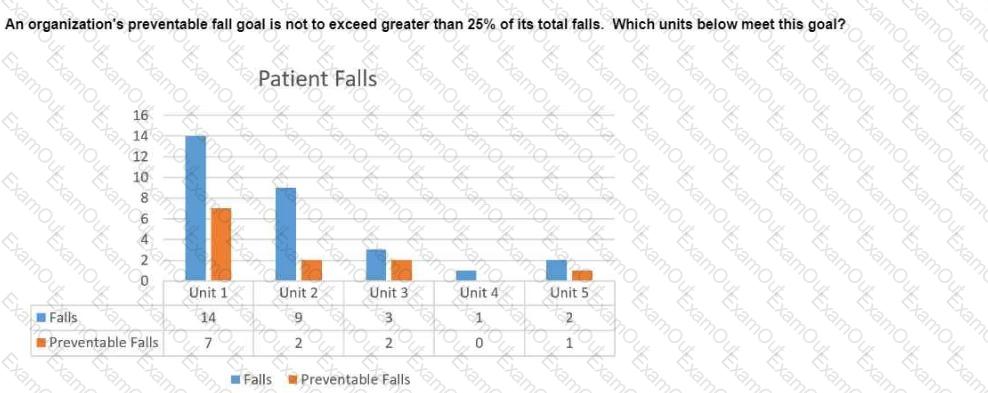
An organization's preventable fall goal is not to exceed greater than 25% of its total falls. Which units below meet this goal?
A.

Units 3 and 4

B.

Units 1 and 2

C.

Units 4 and 5

D.

Units 2 and 4

The ultimate responsibility for ensuring and maintaining patient safety in a healthcare organization lies with the:

A.

Vice President of Quality

B.

Governing Body

C.

Patient Safety Officer

D.

CEO

To assist a primary care physician to improve their performance on a pay-for-performance program, the quality professional should begin with

A.

Obtaining a copy of the current measures for the physician

B.

Suggesting the physician take a course on measurement

C.

Writing a plan to improve processes in the office

D.

Researching benchmarking data for practices in the area

The quality improvement tool used to identify special-cause variation in a process is a:

A.

Pareto Chart

B.

Flowchart

C.

Run Chart

D.

Control Chart

Following the opening of a new stand-alone behavioral health center, the director is challenged with development of a Quality Council. After identifying membership, the next step is to

A.

Educate members on regulatory processes

B.

Identify quality priorities

C.

Charter project improvement teams

D.

Develop quality indicators

An organization conducts daily briefing sessions. Which of the following questions demonstrates a culture of safety?

A.

"Do we have available beds in the ICU?"

B.

"Did anything happen last night that could lead to a central line infection?"

C.

"Who is the last person that committed a medication error?"

D.

"What was the patient’s intake and output?"

Within the strategic management process, which of the following actions is most relevant indetermining what projects are feasible for an organization?

A.

Performing a stakeholder analysis

B.

Identifying strategic opportunities and threats

C.

Reviewing resources, capabilities, and core competencies

D.

Completing a community health needs assessment

The purpose of considering social determinants of health during quality improvement activities is to achieve

A.

global health.

B.

community health.

C.

social justice.

D.

health equity.

Which of the following best describes an incidence rate?

A.

Number of cases with specific characteristics at a specific point in time divided by the total population at risk

B.

Number of new cases identified with a specific characteristic during a specific time period divided by the total population at risk

C.

Total population at risk divided by the number of new cases with a specific characteristic for a specific time period

D.

Number of cases with specific characteristics during a specific time period divided by the total population at risk