
You have a GitHub Codespaces environment that has GitHub Copilot Chat installed and is connected to a SQL database in Microsoft Fabric named DB1 DB1 contains tables named Sales.Orders and Sales.Customers.
You use GitHub Copilot Chat in the context of DB1 .
A company policy prohibits sharing customer Personally Identifiable Information (Pll), secrets, and query result sets with any Al service.
You need to use GitHub Copilot Chat to write and review Transact-SQL code for a new stored procedure that will join Sales.Orders to sales .Customers and return customer names and email addresses. The solution must NOT share the actual data in the tables with GitHub Copilot Chat.
What should you do?
You have an Azure SQL database that contains tables named dbo.ProduetDocs and dbo.ProductuocsEnbeddings. dbo.ProductOocs contains product documentation and the following columns:
• Docld (int)
• Title (nvdrchdr(200))
• Body (nvarthar(max))
• LastHodified (datetime2)
The documentation is edited throughout the day. dbo.ProductDocsEabeddings contains the following columns:
• Dotid (int)
• ChunkOrder (int)
• ChunkText (nvarchar(aax))
• Embedding (vector(1536))
The current embedding pipeline runs once per night
Vou need to ensure that embeddings are updated every time the underlying documentation content changes The solution must NOT ' equire a nightly batch process.
What should you include in the solution?
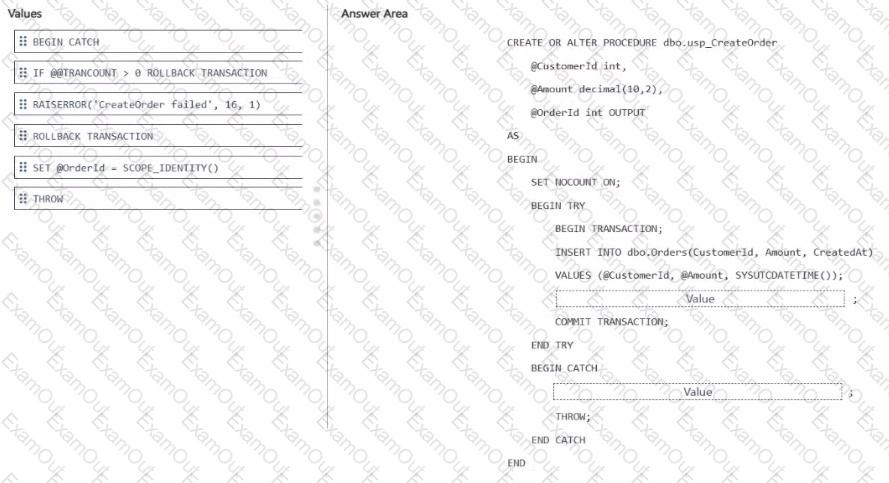
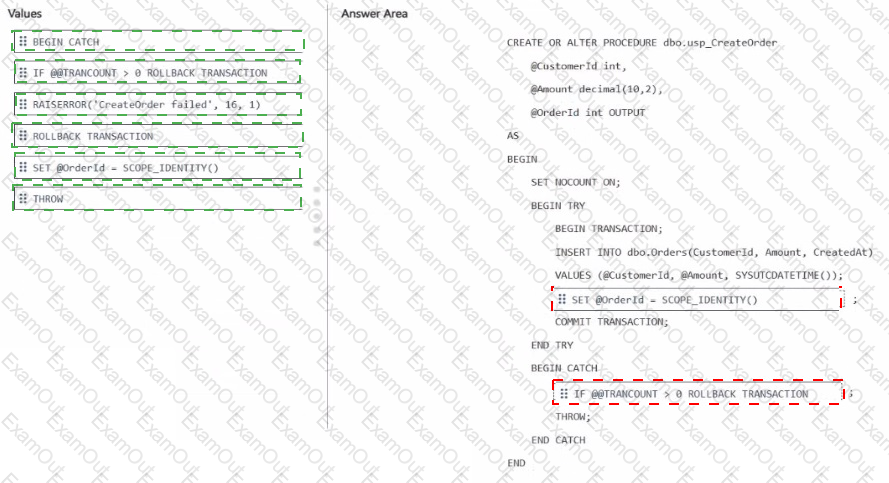
You have an Azure SQL database that contains a table named dbo.Orders.
You have an application that calls a stored procedure named dbo.usp_tresteOrder to insert rows into dbo.Orders.
When an insert fails, the application receives inconsistent error details.
You need to implement error handling to ensure that any failures inside the procedure abort the transaction and return a consistent error to the caller.
How should you complete the stored procedure? To answer, drag the appropriate values to the correct targets, tach value may be used once, more than once, or not at all. You may need to drag the split bar between panes or scroll to view content.
NOTE: Each correct selection is worth one point.
Your company has an ecommerce catalog in a Microsoft SQL Server 202b database named SalesDB SalesDB contains a table named products, products contains the following columns:
• product.id (int)
• product_name (nvarchar(200))
• description (nvarchar(max))
• category (nvarchar(50))
• brand (nvarchar(W))
• price (decimal)
• sku (nvarchar(40))
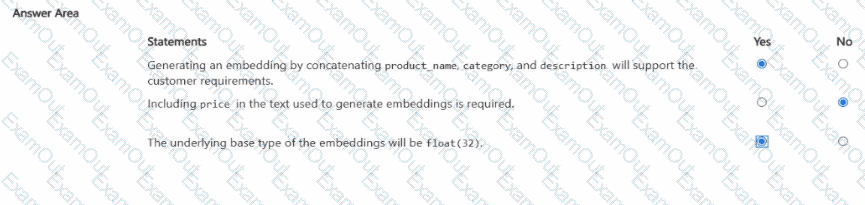
The description fields ate updated dairy by a content pipeline, and price can change multiple times per day. You want customers to be able to submit natural language queries and apply structured filters for brand and price. You plan to store embeddings in a new VECTOR(1536) column and use VECTOR_SEARCH(... METRIC=’ cosine ' ...).
For each of the following statements, select Yes if the statement is true. Otherwise, select No.
NOTE: Each correct selection is worth one point.


You have a Microsoft SQL Server 2025 instance that contains a database named SalesDB SalesDB supports a Retrieval Augmented Generation (RAG) pattern for internal support tickets. The SQL Server instance runs without any outbound network connectivity.
You plan to generate embeddings inside the SQL Server instance and store them in a table for vector similarity queries.
You need to ensure that only a database user account named AlApplicationUser can run embedding generation by using the model.
Which two actions should you perform? Each correct answer presents part of the solution.
NOTE: Each correct selection is worth one point.
You have an Azure SQL database named SalesDB that contains tables named Sales.Orders and Sales.OrderLines. Both tables contain sales data
You have a Retrieval Augmented Generation (RAG) service that queries SalesDB to retrieve order details and passes the results to a large language model (ILM) as JSON text. The following is a sample of the JSON.
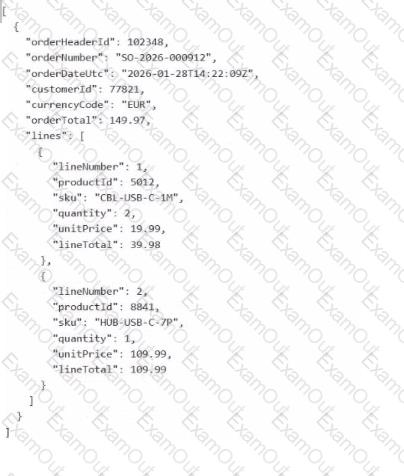
You need to return one 1SON document per order that includes the order header fields and an array of related order lines. The LIM must receive a single JSON array of orders, where each order contains a lines property that is a JSON array of line Items.
Which transact-SQL commands should you use to produce the required JSON shape from the relational tables? To answer, drag the appropriate commands to the correct operations. Each command may be used once, more than once, or not at all. Vou may need to drag the split bar between panes or scroll to view content.
NOTE: Each correct selection is worth one point.


You need to generate embeddings to resolve the issues identified by the analysts. Which column should you use?
You need to recommend a solution that will resolve the ingestion pipeline failure issues. Which two actions should you recommend? Each correct answer presents part of the solution. NOTE: Each correct selection is worth one point.
