Summer Sale Special - Limited Time 70% Discount Offer - Ends in 0d 00h 00m 00s - Coupon code: sntaclus

You have a container in an Azure Cosmos DB Core (SQL) API account.

You need to use the Azure Cosmos DB SDK to replace a document by using optimistic concurrency.

What should you include in the code? To answer, select the appropriate options in the answer area.

NOTE: Each correct selection is worth one point.
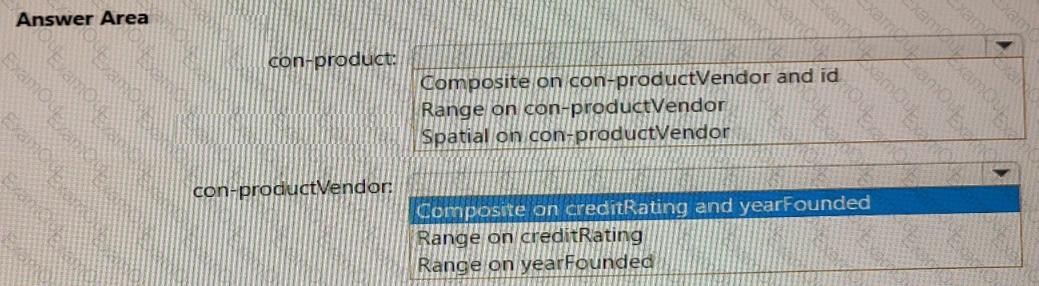
You have an Azure Cosmos DB for NoSQL account that uses a custom conflict resolution policy. The account has a registered merge procedure that throws a runtime exception. The runtime exception prevents conflicts from being resolved.

You need to use an Azure function to resolve the conflicts. What should you use?

A.

a function that pulls items from the change feed and is triggered by a timer trigger

B.

a function that receives items pushed from the conflicts feed and is triggered by an Azure Cosmos DB trigger

C.

a function that pulls items from the conflicts feed and is triggered by a timer trigger

D.

a function that receives items pushed from the change feed and is triggered by an Azure Cosmos DB trigger

You have a development environment that uses multiple Azure subscriptions.

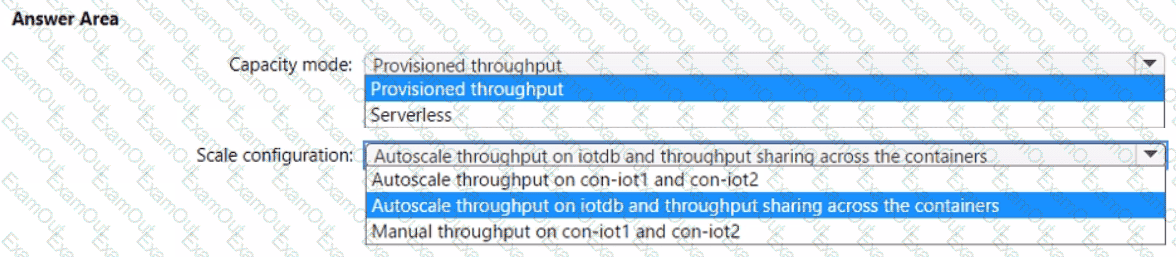
You plan to deploy a single Azure Cosmos DB account that will contain a single database in each subscription.

You need to automate the deployment by using an Azure Resource Manager (ARM) template. The solution must meet the following requirements:

• Minimize Azure Cosmos DB-related charges.

• Maximize the available request units per second (RU/s) without increasing costs.

How should you complete the template? To answer, select the appropriate options in the answer area. NOTE: Each correct selection is worth one point.
You have an Azure Cosmos OB for NoSQL account configured for global distribution across four regions. At connection time, the SQL SDK needs to identify the optimal endpoint for reading and writing. Which two factors can influence the SDK? Each correct answer presents a complete solution NOTE- Each correct selection is worth one point.

A.

the consistency level in Requestoptions

B.

the PreferredLocations configuration

C.

the default consistency level

D.

regional latency

E.

a region being available

You plan to implement an Azure Cosmos DB container that will store telemetry data from 1,000 loT devices. The data will be updated once every minute. An app will read the data once daily and generate aggregated reports that summarize the state of each device.

You need to configure a partition key for the container. The solution must meet the following requirements:

• Minimize the possibility of reaching the partition limits.

• Spread read and write operations evenly across the partitions.

• Minimize how long it takes to locate a specific set of telemetry values.

To what should you set the partition key?

A.

the date and a random value

B.

the device ID and date

C.

the device ID

D.

the date

You have a container in an Azure Cosmos DB for NoSQL account.

You need to create an alert based on a custom Log Analytics query.

Which signal type should you use?

A.

Metrics

B.

Log

C.

Activity Log

D.

Resource Health

You have an Azure Cosmos DB for NoSQL database named DB1 that hosts a container named Container1. The partition key for Container 1 is /pki.

You have a .NET app that connects to DBi.

You need to retrieve the request unit (RU) cost of a point operation and store the value as a variable.

How should you complete the C# code? To answer, select the appropriate options in the answer area.

NOTE: Each correct selection is worth one point.
You need to create a data store for a directory of small and medium-sized businesses (SMBs). The data store must meet the following requirements:

* Store companies and the users employed by them. Each company will have less than 1,000 users.

* Some users have data that is greater than 2 KB.

* Associate each user to only one company.

* Provide the ability to browse by company.

* Provide the ability to browse the users by company.

* Whenever a company or user profile is selected, show a details page for the company and all the related users.

* Be optimized for reading data.

Which design should you implement to optimize the data store for reading data?

A.

In a directory container, create a document for each company and a document for each user. Use company ID as the partition key.

B.

In a company container, create a document for each company. Embed the users into company documents. Use the company ID as the partition key.

C.

Create a user container that uses the user ID as the partition key and a company container that container that uses the company ID as the partition key. Add the company ID to each user documents.

D.

In a user container, create a document for each user. Embed the company into each user document. Use the user ID as the partition key.

You have an Azure subscription that contains an Azure Cosmos DB for NoSQL database named DB1.

You develop a software as a service (SaaS) app named App1 that uses DB1. App1 will be used by multiple vendors to manage their customers.

You need to create a container in DB1 that will store customer and order details for each vendor. The solution must meet the following requirements:

• Each vendor must have a unique tenant ID.

• The performance of the container must be optimized for reads.

• Customer IDs can be duplicated across the container but must be unique for each vendor.

• The container must be optimized for concurrent queries from multiple customers. Each query will return data for a single vendor.

How should you configure the container?

A.

Add a partition key to the tenant ID and a unique key policy to the customer ID.

B.

Add hierarchical partition key on (tenant identifier, customer identifier).

C.

Add a partition key to the customer ID and a unique key policy to the tenant ID.

D.

Add hierarchical partition key on (customer identifier, tenant identifier).

You have an Azure Cosmos DB for NoSQL account that contains a container named Container1.

You add a composite index to the default indexing policy of Container1. The index has the following definition.

FirstName ASC, age ASC

You plan to execute the following query against Container1.

You need to optimize the performance of the query by adding an additional index.

How should you complete the additional index? To answer, select the appropriate options in the answer area

NOTE: Each correct selection is worth one point.