You have a container named container1 in an Azure Cosmos DB Core (SQL) API account.
The following is a sample of a document in container1.
{
" studentId " : " 631282 " ,
" firstName " : " James " ,
" lastName " : " Smith " ,
" enrollmentYear " : 1990,
" isActivelyEnrolled " : true,
" address " : {
" street " : " " ,
" city " : " " ,
" stateProvince " : " " ,
" postal " : " " ,
}
}
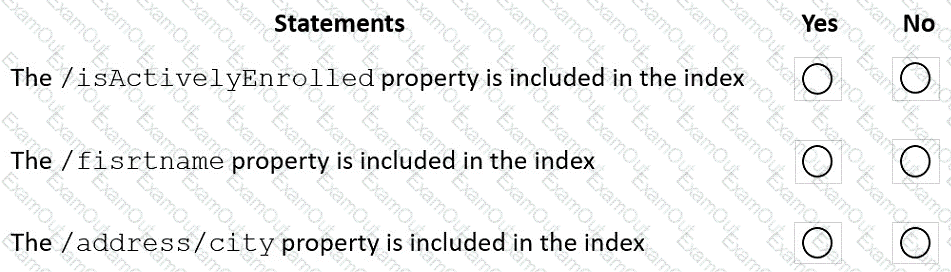
The container1 container has the following indexing policy.
{
" indexingMode " : " consistent " ,
" includePaths " : [
{
" path " : " /* "
},
{
" path " : " /address/city/? "
}
],
" excludePaths " : [
{
" path " : " /address/* "
},
{
" path " : " /firstName/? "
}
]
}
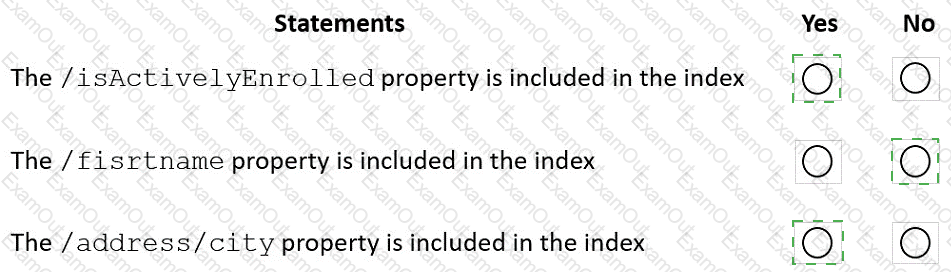
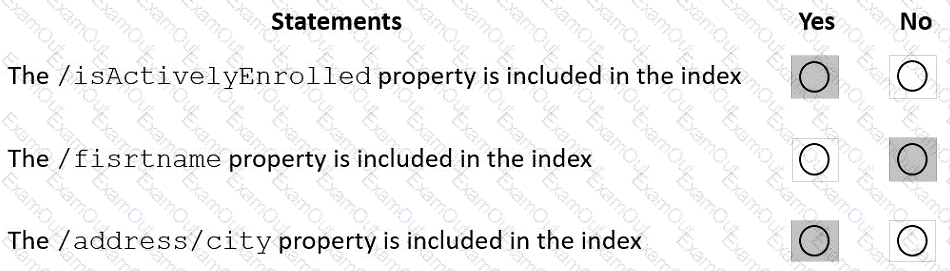
For each of the following statements, select Yes if the statement is true. Otherwise, select No.
NOTE: Each correct selection is worth one point.
You have an Azure Cosmos DB Core (SQL) API account named account1.
In account1, you run the following query in a container that contains 100GB of data.
SELECT *
FROM c
WHERE LOWER(c.categoryid) = " hockey "
You view the following metrics while performing the query.
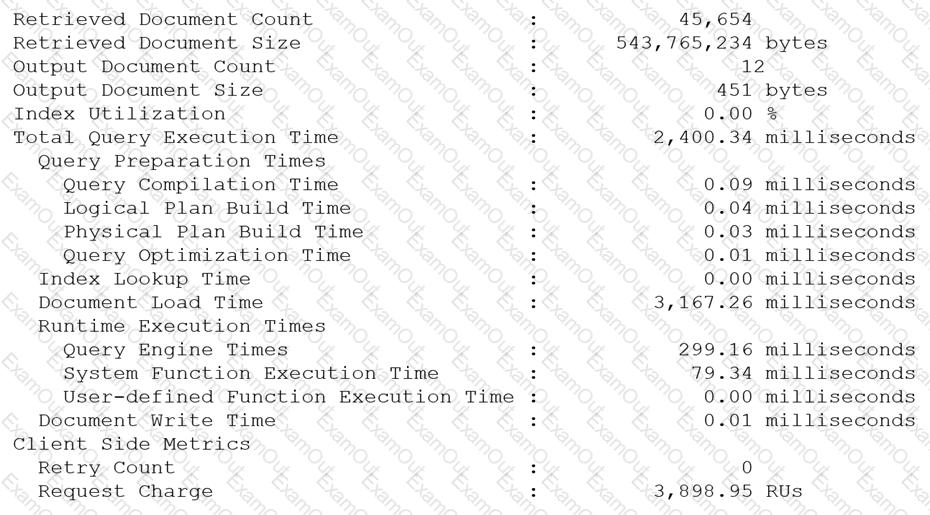
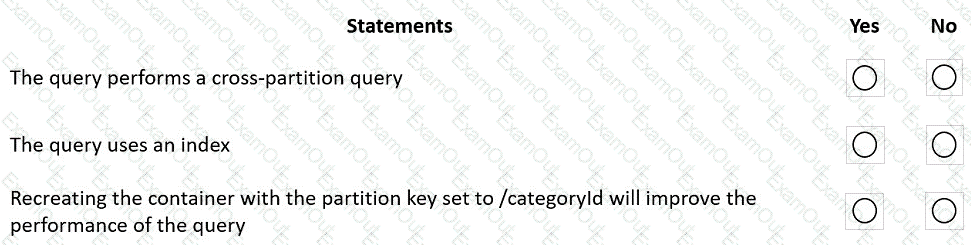
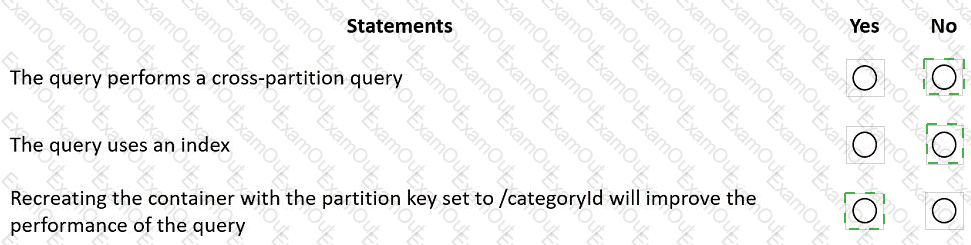
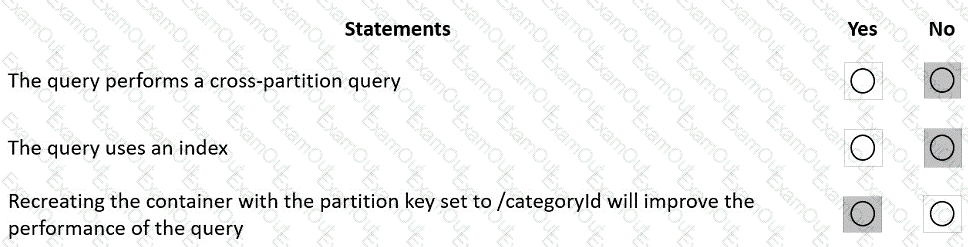
For each of the following statements, select Yes if the statement is true. Otherwise, select No.
NOTE: Each correct selection is worth one point.
You have an Azure Cosmos DB database that hosts a container named container1.
You need to ensure that the items stored in contained will NOT expire unless their TTL value is set explicitly. What should you do?
You maintain a relational database for a book publisher. The database contains the following tables.
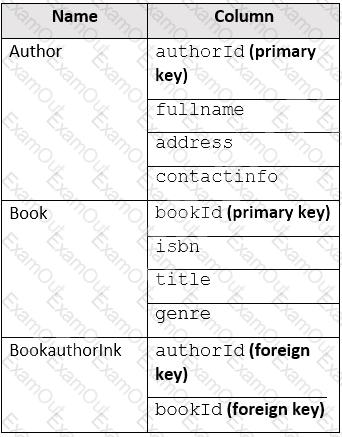
The most common query lists the books for a given authorId.
You need to develop a non-relational data model for Azure Cosmos DB Core (SQL) API that will replace the relational database. The solution must minimize latency and read operation costs.
What should you include in the solution?
You have an Azure Cosmos DB for NoSQL account.
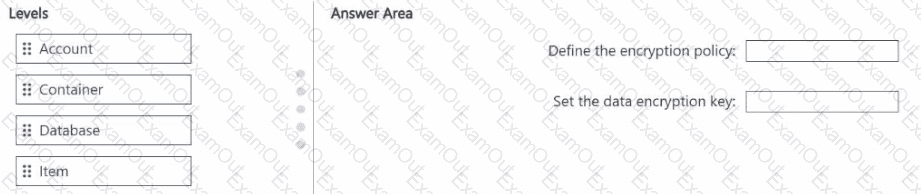
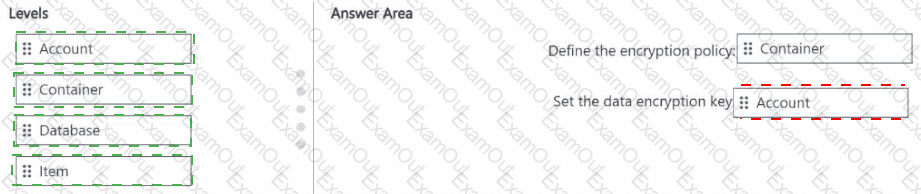
You need to implement Always Encrypted for all the data stored in the account. The solution must minimize administrative effort.
At which level should you define the encryption policy and set the data encryption key? To answer, drag the appropriate levels to the correct requirements. Each level may be used once, more than once, or not at all. You may need to drag the split bar between panes or scroll to view content.
NOTE: Each correct selection is worth one point.
You have an Azure Cosmos DB for NoSQL database that hosts a container named Container^
You are developing a new app named App1 that will use Container 1.
You need to ensure that when App1 attempts to delete a document in Container1, the action is blocked, and an error is returned to the app.
What should you use?
You have an Azure subscription that contains an Azure Cosmos DB for NoSQL account named account! You plan to configure the Apache Kafka service as a data source for account 1. What should you use to store the Kafka configuration?
You plan to create an Azure Cosmos DB for NoSQL account that will have a single write region and three read regions. You need to set the consistency level for the account. The solution must meet the following requirements:
• In the write region, writes must replicate synchronously across at least three replicas.
• In the read regions, reads must see writes in order for transactional batches.
• Throughput for reads and writes must be maximized.
Which consistency level should you select?
Vou have an Azure Cosmos DB for NoSQL account named Cosmos1 that has a container named orders.
You have an app that updates order documents throughout the day. and the documents must remain in orders for transactional queries.
You have an Azure Storage account named account1.
You need to implement an archive process that meets the following requirements,
• Archives each new order document to account1
• Archives each updated order document to account! as the update occurs
• Ensures that the archive process continues from the last processed change after a restart
• Scales across partitions without custom polling or custom checkpoint management
What should you do?
Note: This question is part of a series of questions that present the same scenario. Each question in the series contains a unique solution that might meet the stated goals. Some question sets might have more than one correct solution, while others might not have a correct solution.
After you answer a question in this section, you will NOT be able to return to it. As a result, these questions will not appear in the review screen.
You have an Azure Cosmos DB Core (SQL) API account named account 1 that uses autoscale throughput.
You need to run an Azure function when the normalized request units per second for a container in account1 exceeds a specific value.
Solution: You configure an application to use the change feed processor to read the change feed and you configure the application to trigger the function.
Does this meet the goal?