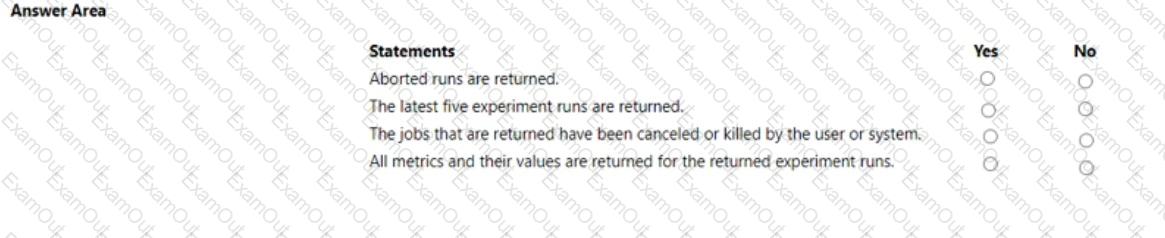
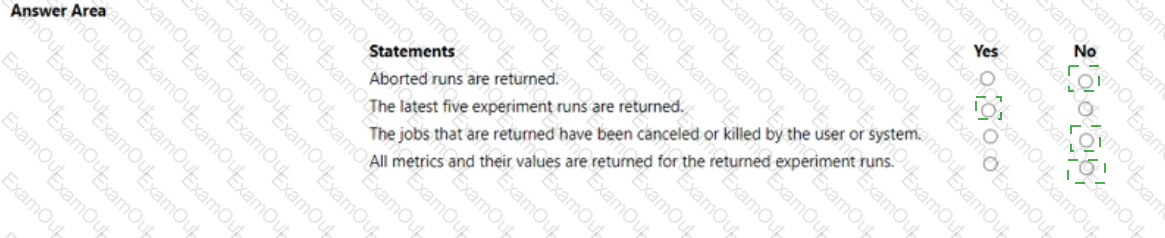
You manage an Azure Machine Learning workspace. You create an experiment named experiment1 by using the Azure Machine Learning Python SDK v2 and MLflow.
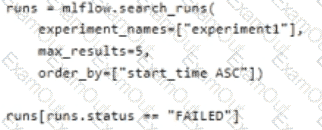
For each of the following statements, select Yes if the statement is true. Otherwise, select No.
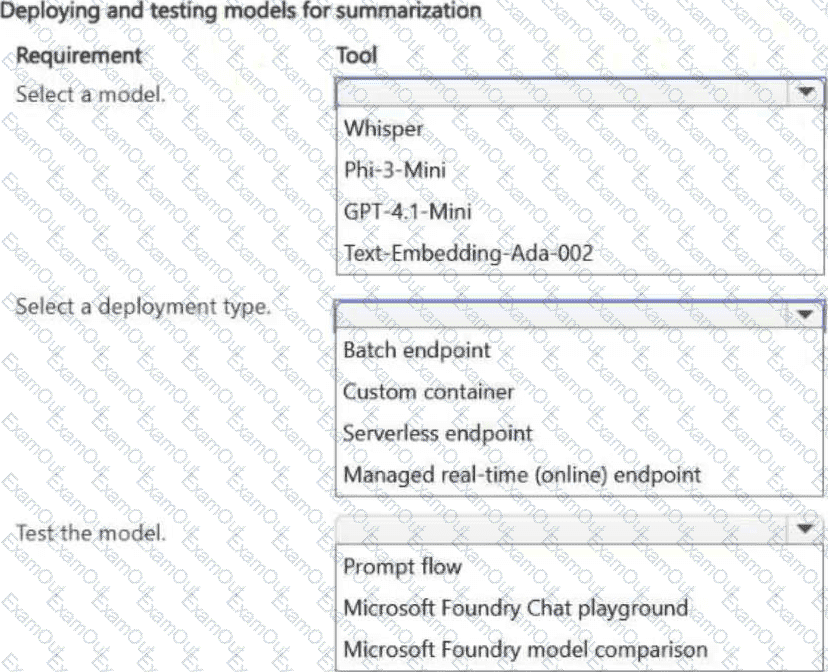
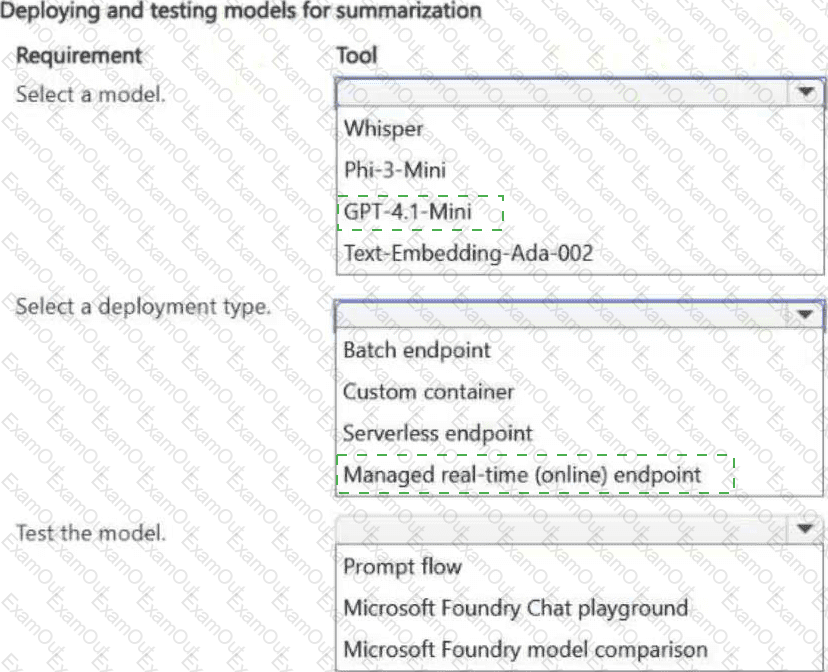
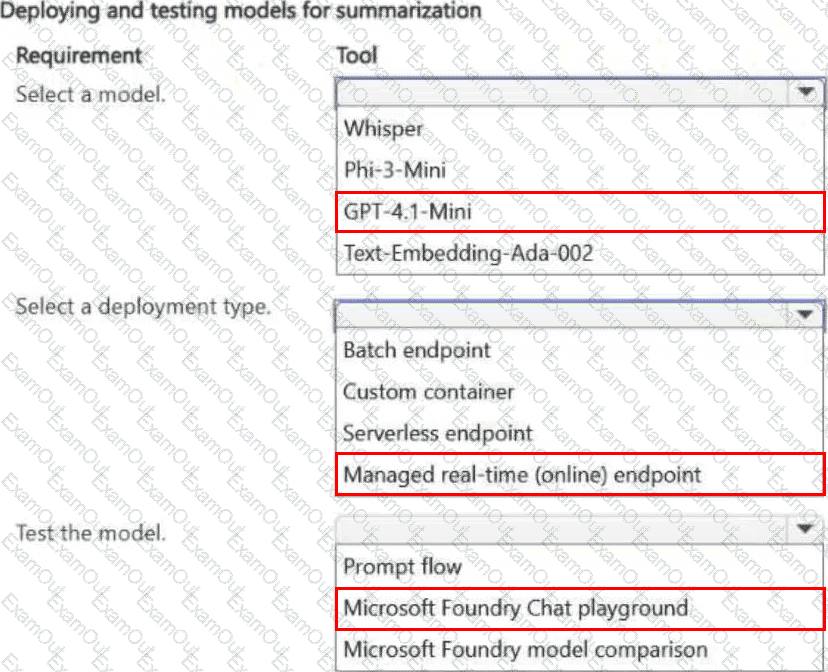
A company is creating an internal tool that summarizes long meeting transcripts and extracts action items.
The model must:
Process text inputs up to 200k tokens long.
Generate concise summaries in seconds.
Support interactive testing before integration into the app.
You need to select, deploy, and test a model that supports summarization with low latency.
How should you complete the configuration plan? To answer, select the appropriate options in the answer area. NOTE: Each correct selection is worth one point.
You manage an Azure Machine Learning workspace by using the Python SDK v2.
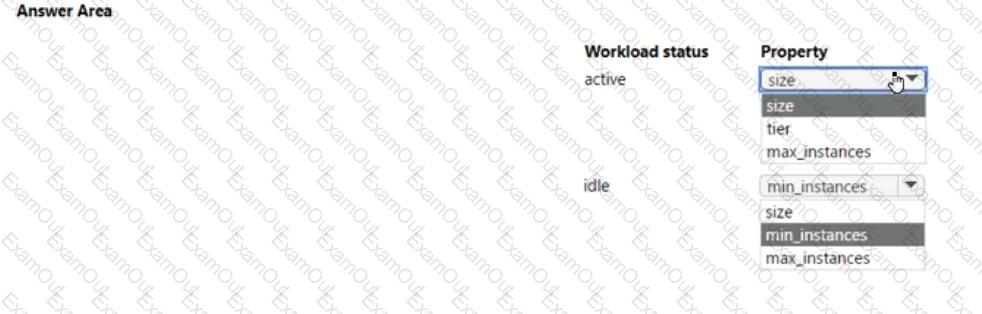
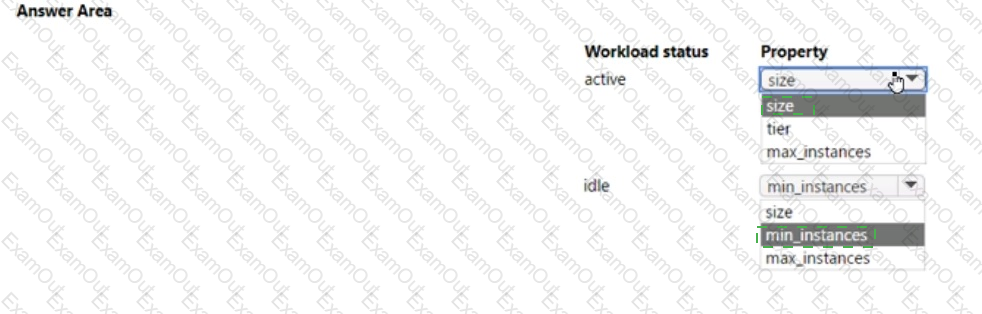
You must create a compute cluster in the workspace. The compute cluster must run workloads and properly handle interruptions. You start by calculating the maximum amount of compute resources required by the workloads and size the cluster to match the calculations.
The cluster definition includes the following properties and values:
• name= " mlcluster1’’
• size= " STANDARD.DS3.v2 "
• min_instances=1
• maxjnstances=4
• tier= " dedicated "
The cost of the compute resources must be minimized when a workload is active Of idle. Cluster property changes must not affect the maximum amount of compute resources available to the workloads run on the cluster.
You need to modify the cluster properties to minimize the cost of compute resources.
Which properties should you modify? To answer, select the appropriate options in the answer area.
NOTE: Each correct selection is worth one point.
You train and publish a machine teaming model.
You need to run a pipeline that retrains the model based on a trigger from an external system.
What should you configure?
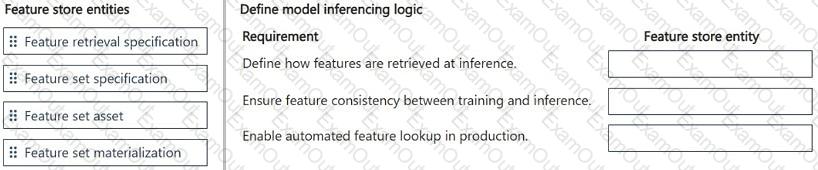
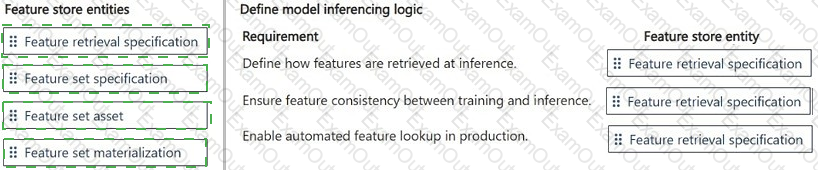
A data science team trains a model that depends on features that are stored in a managed feature store.
The model is registered in Azure Machine Learning and will be deployed to a real-time endpoint.
After deployment, the model must:
• Retrieve feature values dynamically at inference time.
• Use the same feature definitions that were used during training.
• Run without manual configuration changes across environments.
You need to define feature store entities so that feature retrieval behaves as expected when the model is deployed.
Which feature store entity should you select for each requirement? To answer, move the appropriate feature store entities to the correct requirements. You may use each feature store entity once, more than once, or not at all. You may need to move the split bar between panes or scroll to view content.
NOTE: Each correct selection is worth one point.
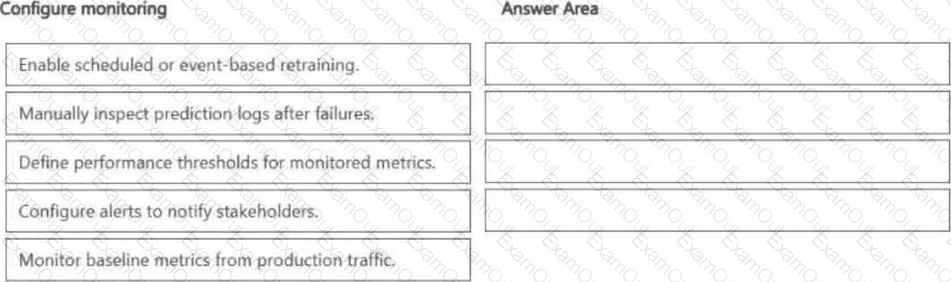
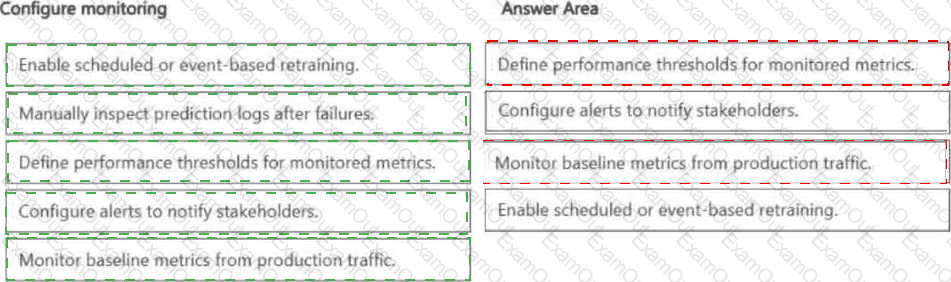
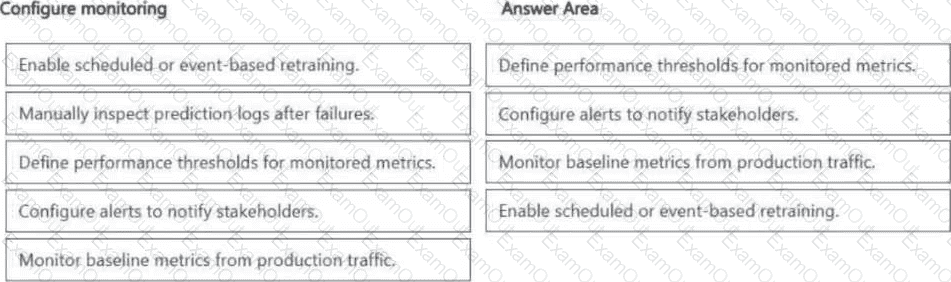
A team deploys a classification model to production and monitors performance and data changes.
The team wants to ensure that significant drops in prediction accuracy automatically trigger the following:
Stakeholders must be notified of the drops.
Retraining must be initiated when thresholds are exceeded
You need to configure monitoring to meet the requirements.
Which four actions should you perform in sequence? To answer, move the appropriate actions from the list of actions to the answer area and arrange them in the correct order.
You have an Azure Machine Learning workspace.
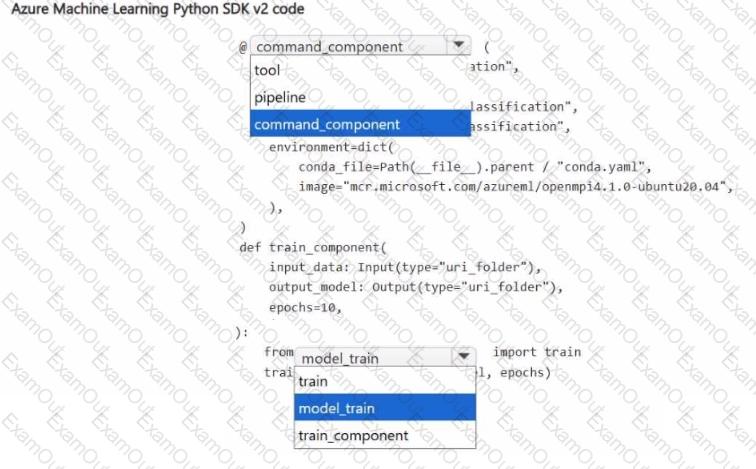
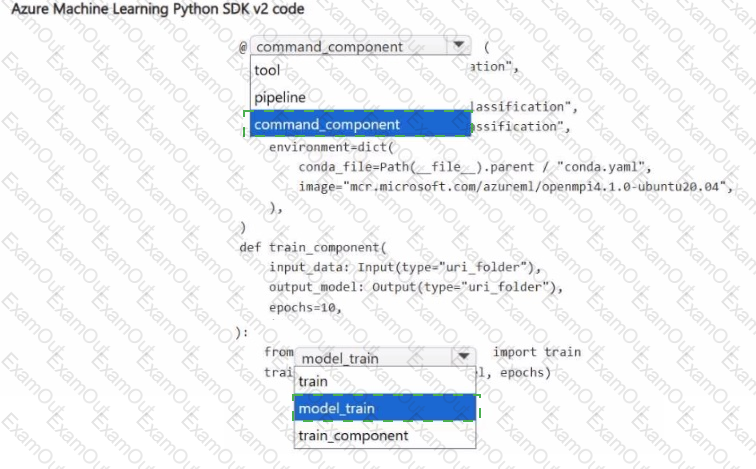
You plan to use Azure Machine Learning Python SDK v2 to define a pipeline component that trains an image classification model. The execution logic of the component is contained in the train() function in the file named modeljrain.py.
You write code to import all required libraries and store it as train_component.py in the same folder that contains model_train.py.
You need to complete the remaining code in train_component.py.
How should you complete the code? To answer, select the appropriate options in the answer area.
NOTE: Each correct selection is worth one point.
You are planning to register a trained model in an Azure Machine Learning workspace.
You must store additional metadata about the model in a key-value format. You must be able to add new metadata and modify or delete metadata after creation.
You need to register the model.
Which parameter should you use?
-
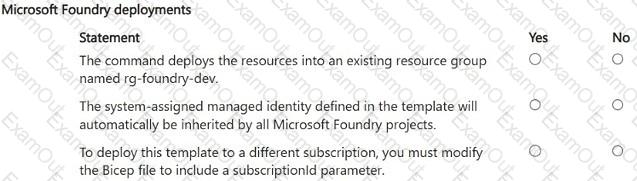
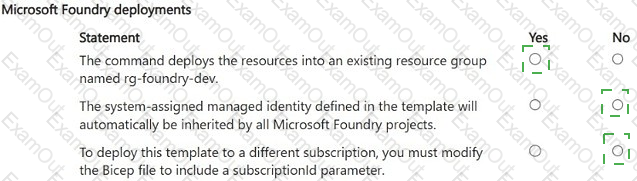
You review the following Azure CLI command and the relevant Bicep excerpt.
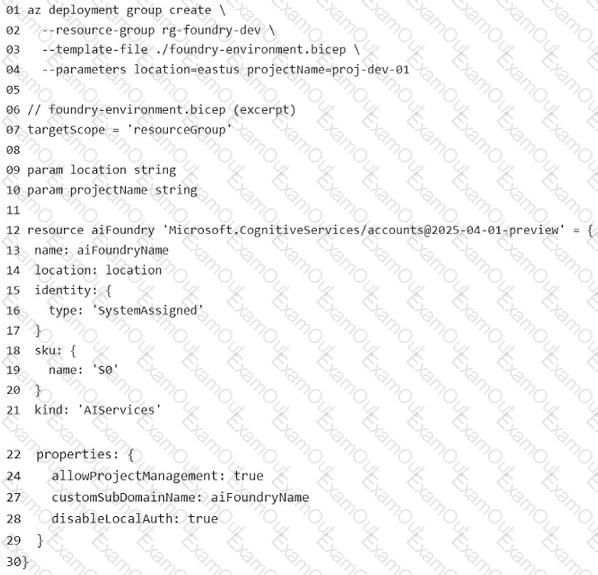
(Non-relevant sections are omitted.)
You need to validate what the snippet will do before it is merged. For each of the following statements, select Yes if the statement is true. Otherwise, select No.
NOTE: Each correct selection is worth one point.
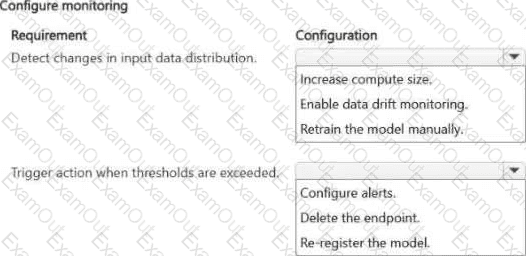
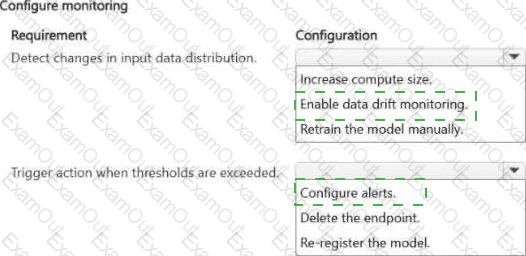
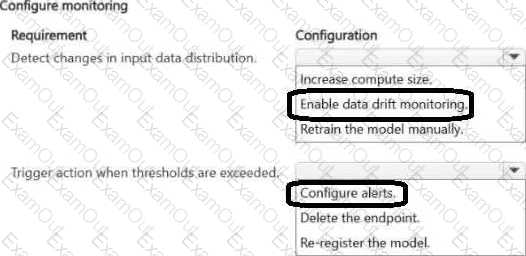
A machine learning model is deployed to production in Azure Machine Learning and is actively serving predictions for a business application. The model was trained by using a historical dataset that represented expected input patterns at the time of deployment.
The team working on the model must ensure the following:
Changes in input data distribution are detected.
Appropriate actions are triggered when predefined thresholds are exceeded.
You need to configure monitoring to meet the requirements.
Which configuration should you use for each requirement? To answer, select the appropriate options in the answer area. NOTE: Each correct selection is worth one point.