Month End Sale Special - Limited Time 70% Discount Offer - Ends in 0d 00h 00m 00s - Coupon code: sntaclus

You are implementing an EVPN-VXLAN edge-routed bridging design using Layer 3 gateway operations. In this scenario, which statement is correct?

A.

Each distribution switch has unique IP addresses for IRB interfaces; routing protocols run on IRB interfaces

B.

Distribution switches share the same anycast IP addresses for IRB interfaces; routing occurs at the distribution layer.

C.

Only core switches have IRB interfaces; all Layer 3 routing happens in the core.

D.

IRB interfaces are disabled; all routing happens through external routers only.

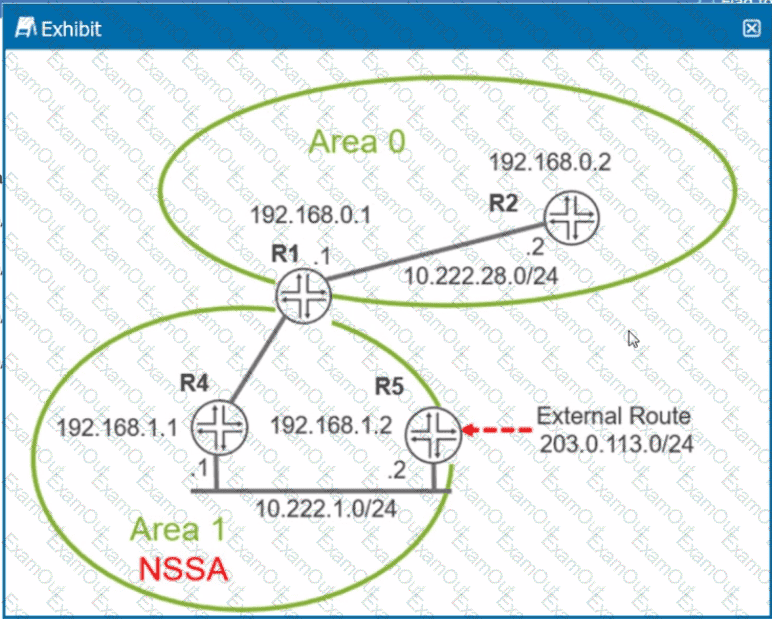
Exhibit

You are receiving the 203 0.113.0/24 route from both upstream ISPs You are asked to ensure that ISP A is the preferred ISP for traffic being sent to the 203.0.113.0/24 network from devices in AS 65512.

Referring to the exhibit, which two statements will accomplish this behavior? (Choose two.)

A.

You should assign a local preference that is lower than 100 for the route learned from ISP A.

B.

You should assign a local preference that is higher than 100 for the route learned from ISP A.

C.

You should assign a local preference that is lower than 100 for the route learned from ISP B.

D.

You should assign a local preference that is higher than 100 for the route learned from ISP B.

You want to implement a system in your network to simplify VLAN management that can also dynamically create and prune VLANs. How would you accomplish this task?

A.

Enable GVRP on access interfaces.

B.

Enable MVRP and GVRP on all interfaces.

C.

Enable MVRP on trunk interfaces.

D.

Enable MVRP on access interfaces.

An incorrectly configured routing policy at your service provider led to several hundred thousand routes being placed in your edge router's routing table In this scenario, how would you limit the number of prefixes received on a BGP peer session?

A.

Enable the damping BGP parameter in the edge router configuration

B.

Enable the prefix-limit BGP parameter in the edge router configuration.

C.

Enable the graceful-restart BGP parameter in the edge router configuration.

D.

Enable the advertise-inactive BGP parameter in the edge router configuration.

You are adding a new QFX Series switch to an EVPN-VXLAN IP fabric.

In this scenario, which two statements are correct? (Choose two.)

A.

The encapsulation vxlan setting is configured under the protocols evpn hierarchy.

B.

The family vpls signaling address family is configured under the BGP protocol.

C.

The family evpn signaling address family is configured under the BGP protocol.

D.

The loopback interface must be advertised using the BGP protocol.

Exhibit

Referring to the exhibit output, which statement is correct?

A.

The device with an IP address of 192.168.100 2 is attached to VNI 5010

B.

The output shows the router ID of the device sending the EVPN Type 2 routes

C.

The output shows the route distinguisher of the device sending the EVPN Type 2 routes

D.

IP addresses 10.1.1.1 and 10.1 2.3 are connected to the same VNI.

Which two statements are correct when using the no-loss forwarding class? (Choose two.)

A.

Use the default scheduler map

B.

Use forwarding class sets.

C.

Use priority-based flow control.

D.

Use the default drop profile.

Exhibit.

Referring to the exhibit. Ieaf2 is elected the designated forwarder

Which two statements are correct if server2 generates a broadcast frame*? (Choose two.)

A.

The broadcast frame will be forwarded to leaf1 and Ieaf2.

B.

The broadcast frame will not be forwarded to leaf1.

C.

Only Ieaf2 will forward the broadcast frame to server1

D.

Only leaf1 will forward the broadcast frame to server1.

Which two statements are correct about multicast routing tables? (Choose two.)

A.

inet. 2 is used when the multicast forwarding topology differs from unicast forwarding

B.

MBGP and IS-IS place routes in met. l directly.

C.

inet. 0 is used for RPF checks.

D.

IS-IS and OSPFv3 place routes in met. 2 directly.

Exhibit

You configured MVRP in your Layer 2 network using the configuration shown in the exhibit. You verified that the appropnate VLANs are configured and applied on the two access switches. You are using RSTP as your loop prevention mechanism. Unfortunately, the users are not able to communicate with their corresponding server attached to the Access-2 switch.

In this scenario, what should you do to solve this problem?

A.

Configure VSTP instead of RSTP as your loop-prevention mechanism.

B.

Configure the access interfaces on the Access-2 switch under MVRP.

C.

Configure the ge-070716.0 interface on the Core-1 switch under MVRP.

D.

Configure the access interfaces on the Access-1 switch under MVRP.