
Spring Sale Special - Limited Time 70% Discount Offer - Ends in 0d 00h 00m 00s - Coupon code: sntaclus

The following table shows six test cases TC01 to TC06 with their priorities and dependencies.
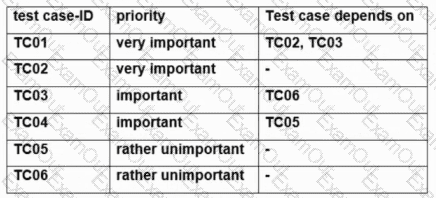
Schedule the test execution of the specified test case set according to the priorities and dependencies. Since the test time is very tight, the number of test cases should be minimized as much as possible, but all very important test cases must be included.

Which of the following statements is correct?

A.

TC04, TC05, and TC06 can be deleted.

B.

TC05 and TC06 can be deleted.

C.

TC04 and TC05 can be deleted.

D.

TC03, TC04 and TC05 can be deleted.

Which ONE of the following options MOST ACCURATELY describes branch testing?

A.

In branch testing, the coverage items are executable statements. The aim is to design test cases that exercise statements in the code until an acceptable level of coverage is achieved, expressed as a percentage.

B.

In branch testing, the coverage items are control flow transfers between decisions, and the aim is to design test cases to exercise flow transfers in the code until an acceptable level of coverage is achieved. Coverage is measured as the number of branches exercised by the test cases divided by the total number of branches expressed as a percentage.

C.

In branch testing, the coverage items are branches, and the aim is to design test cases to exercise branches in the code until an acceptable level of coverage is achieved. Coverage is measured as the number of branches exercised by the test cases divided by the total number of branches expressed as a percentage.

D.

In branch testing, the coverage items are executable decisions. The aim is to design test cases that exercise statements in the code until an acceptable level of coverage is achieved. Coverage is expressed as a percentage.

Which of the following statements is NOT true about Configuration management and software testing?

A.

Configuration management helps maintain consistent versions of software artifacts.

B.

Configuration management supports the build process, which is essential for delivering a test release into the test environment.

C.

When testers report defects, they need to reference version-controlled items.

D.

Version controlled test ware increases the chances of finding defects in the software under test.

Which of the following statements about static testing and dynamic testing is TRUE?

A.

Static testing is better suited than dynamic testing for highlighting issues that could indicate inappropriate code modulansation.

B.

Dynamic testing can only be applied to executable work products, while static testing can only be applied to non-executable work products.

C.

Both dynamic testing and static testing cause failures, but failures caused by static testing are usually easier and cheaper to analyse.

D.

Security vulnerabilities can only be detected when the software is being executed, and thus they can only be detected through dynamic testing, not through static testing

Which of the following statements about static analysis are FALSE?

I. Static analysis can be used Instead of dynamic testing.

II. Stalk: analysis can uncover defects like security vulnerabilities.

III. Static analysis can be used to check conformance to specifications and standards.

IV Static analysis typically detects failures prior to component testing.

A.

I. II

B.

II. Ill

C.

III. IV

D.

I, IV

Consider the following testing levels:

1) Component Testing

2) Integration Testing

3) System Testing

4) Acceptance Testing

Which of the following statements is true?

A.

Integration and system testing are applicable when V-model is used.

Component and acceptance testing are applicable when iterative development models are used.

B.

All the testing levels are applicable to V-model for software development.

Only acceptance testing is applicable for iterative models.

C.

Acceptance testing is applicable for all software development models.

Component and system testing are applicable only for the V-model.

D.

All testing levels are applicable, independent of which software development life-cycle process (V-model. iterative, incremental) is used.

Which of the following statements about re-testing and regression testing are TRUE?

I Re-testing should be performed after a defect is fixed.

II Regression testing should always be performed after a defect is fixed.

III. Re-testing and regression testing may be performed at any test level.

IV Regression testing may include functional, non-functional and structural testing.

V. Re-testing should be included in the debugging activity.

A.

I, III. Iv

B.

II, v

C.

I, Ill

D.

II. IV, V

Which description reflects aspects of checklist-based testing?

A.

The checklist contains test cases that need to be executed in a certain order (e.g. defect-detecting test cases from previous projects).

B.

The checklist includes failure descriptions that have been found in the past which should be avoided.

C.

The checklist contains experience-based test conditions, mostly in the form of questions and based on causes of previous failures, which are used when creating the test.

D.

The checklist contains common testing techniques (e.g. equivalence class partitioning) and their uses to simplify the selection of the "appropriate" test techniques.

Which of the following statements regarding inspection is NOT true?

A.

An inspection may be led by a trained moderator who shall not be the author.

B.

The main purpose of an inspection is to find solutions to the problems.

C.

An inspection can be performed by peers.

D.

An inspection shall follow a formal process based on rules and checklists with entry and exit criteria

Which of the following options is correct with respect to the differentiation of black-box techniques, white-box techniques, and experience-based testing?

A.

Black-box test techniques are based on requirements, white-box tests on source code. Therefore, black-box test techniques are always performed at higher test levels (e.g. system and acceptance level) and white-box test techniques at lower test levels.

B.

Experience-based testing can complement white-box and black-box test techniques well or can be used if the basic principles for these test techniques are lacking.

C.

Experience-based testing is an extension of black-box test techniques, since experience-based test techniques also do not require knowledge about the source code.

D.

The coverage items can be specified in advance, e.g., coverage of statements, states or checklists, for all three of the categories mentioned above.