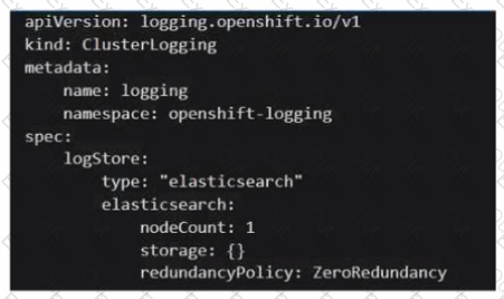
The given YAML configuration is for ClusterLogging in an OpenShift environment, which is used for centralized logging. The key part of the specification that determines the behavior of Elasticsearch is:
logStore:
type: "elasticsearch"
elasticsearch:
nodeCount: 1
storage: {}
redundancyPolicy: ZeroRedundancy
nodeCount: 1
storage: {}
The empty storage field implies no persistent storage is configured.
This means that if the pod is deleted or restarted, all stored logs will be lost.
redundancyPolicy: ZeroRedundancy
ZeroRedundancy means there is no data replication, making the system vulnerable to data loss if the pod crashes.
In contrast, a redundancy policy like MultiRedundancy ensures high availability by replicating data across multiple nodes, but that is not the case here.
Analysis of Key Fields:
Evaluating Answer Choices:Option
Explanation
Correct?
A. A single node ElasticSearch cluster with default persistent storage.
Incorrect, because storage: {} means no persistent storage is configured.
❌
B. A single infrastructure node with persisted ElasticSearch.
Incorrect, as this is not configuring an infrastructure node, and storage is not persistent.
❌
C. A single node ElasticSearch cluster which auto scales when redundancyPolicy is set to MultiRedundancy.
Incorrect, because setting MultiRedundancy does not automatically enable auto-scaling. Scaling needs manual intervention or Horizontal Pod Autoscaler (HPA).
❌
D. A single node ElasticSearch cluster with no persistent storage.
Correct, because nodeCount: 1 creates a single node, and storage: {} ensures no persistent storage.
✅
Final Answer:✅ D. A single node ElasticSearch cluster with no persistent storage.
IBM CP4I Logging and Monitoring Documentation
Red Hat OpenShift Logging Documentation
Elasticsearch Redundancy Policies in OpenShift Logging
IBM Cloud Pak for Integration (CP4I) v2021.2 Administration References: