On the OSPFv3 network shown in the figure, area 1 is a stub area.
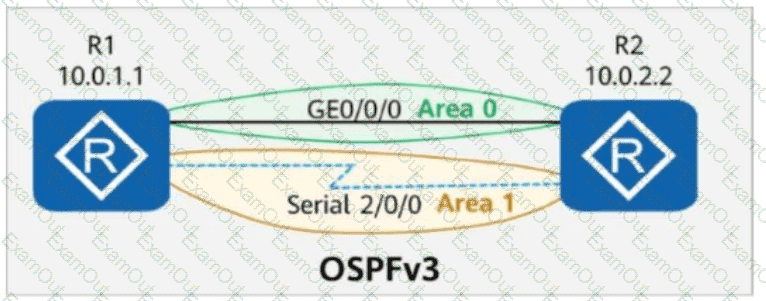
Which of the following LSAs is generated by only one router?
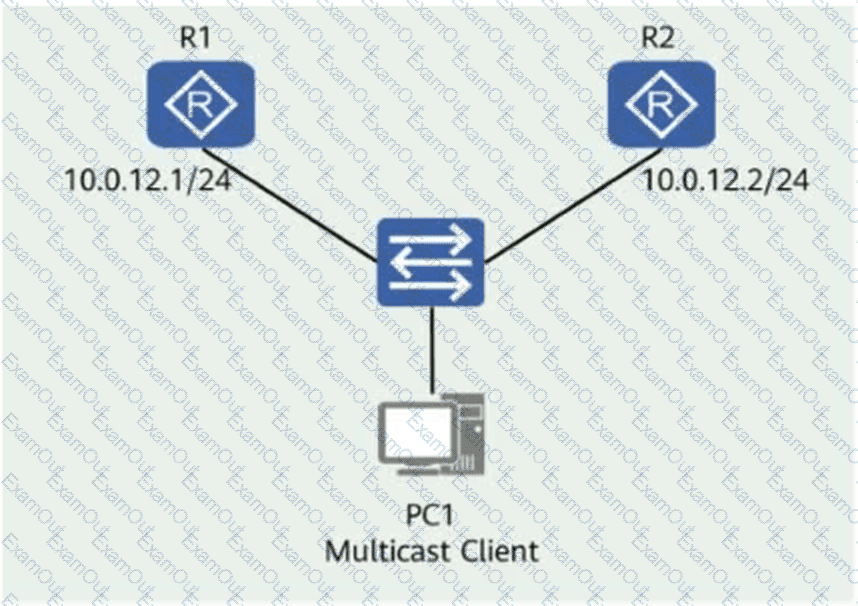
A network engineer draws a schematic diagram of a multicast network (shown in the figure) during troubleshooting. R1 and R2 run IGMP version 2 and use PIM-SM as the multicast routing protocol. The default settings are used for other parameters. Given this, the DR on the multicast network is _____. (Enter the device ID, for example, R1.)
If end-to-end QoS is configured on an MPLS network, the penultimate hop device on the MPLS network can pop MPLS labels from packets based on penultimate hop popping (PHP), so that the egress node can process packets based on the QoS priority in inner packets.
VLAN aggregation is configured on a switched network. Sub-VLAN 2 and Sub-VLAN 3 are added to Super-VLAN 10. To enable hosts in different sub-VLANs to communicate with each other, run the following command in the VLANIF 10 view corresponding to the Super-VLAN.
(Enter lowercase letters.)
Selective QinQ can add different outer tags to different inner packets. Which of the following statements is false about selective QinQ?
Based on the local LSDB, a device that runs OSPF uses the SPF algorithm to calculate the SPT with itself as the root, and determines the next hop to the destination network according to the SPT. If the network changes frequently, you can set the maximum interval for SPF calculation to 0 ms to speed up route convergence.
OSPF requires that routers in the same area have the same link state database (LSDB). As the number of routes on the network increases, some routers cannot carry so much routing information due to limited system resources. This state is called database overflow. If the Isdb-overflow-limit number 7 command is run on all routers on an OSPF network, which of the following conditions are likely to cause routers to enter the overflow state?
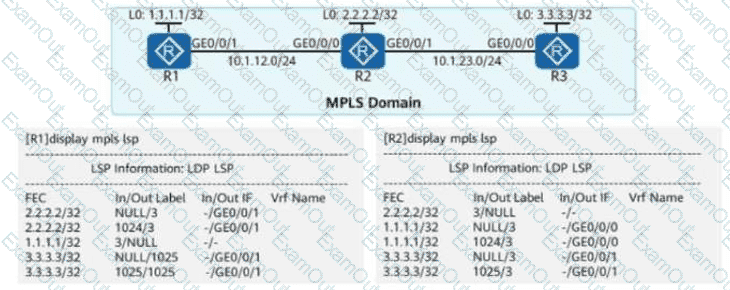
The figure shows the LSP information of R1 and R2 on an MPLS network. An administrator runs the ping 3.3.3.3 command on R1. Given this, which of the following statements is true?
Type 7 LSAs, used to describe imported external routes, were introduced to support NSSAs. They are generated by autonomous system boundary routers (ASBRs) in NSSAs. The flooding scope of Type 7 LSAs is similar to that of Type 5 LSAs. That is, besides being flooded to common areas and stub areas, Type 7 LSAs are also flooded to all NSSAs on the OSPF network.
OSPFv3 packets are encapsulated in IPv6 packets and can be sent in unicast, multicast, or broadcast mode.