In Layer 3 in-path WLAN networking, the WAC and Fit APs are connected at Layer 3. APs can obtain the WAC’s address through broadcast or DHCP.
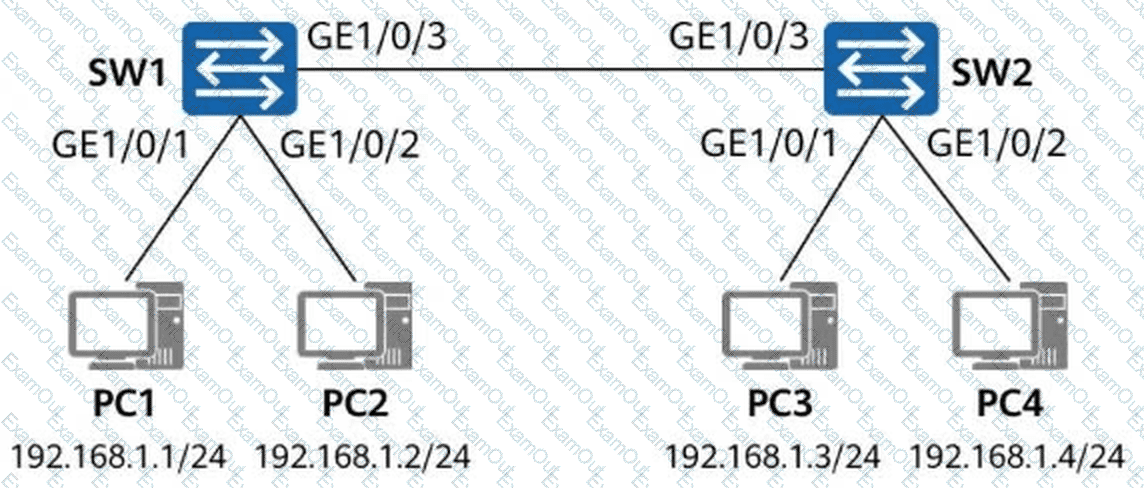
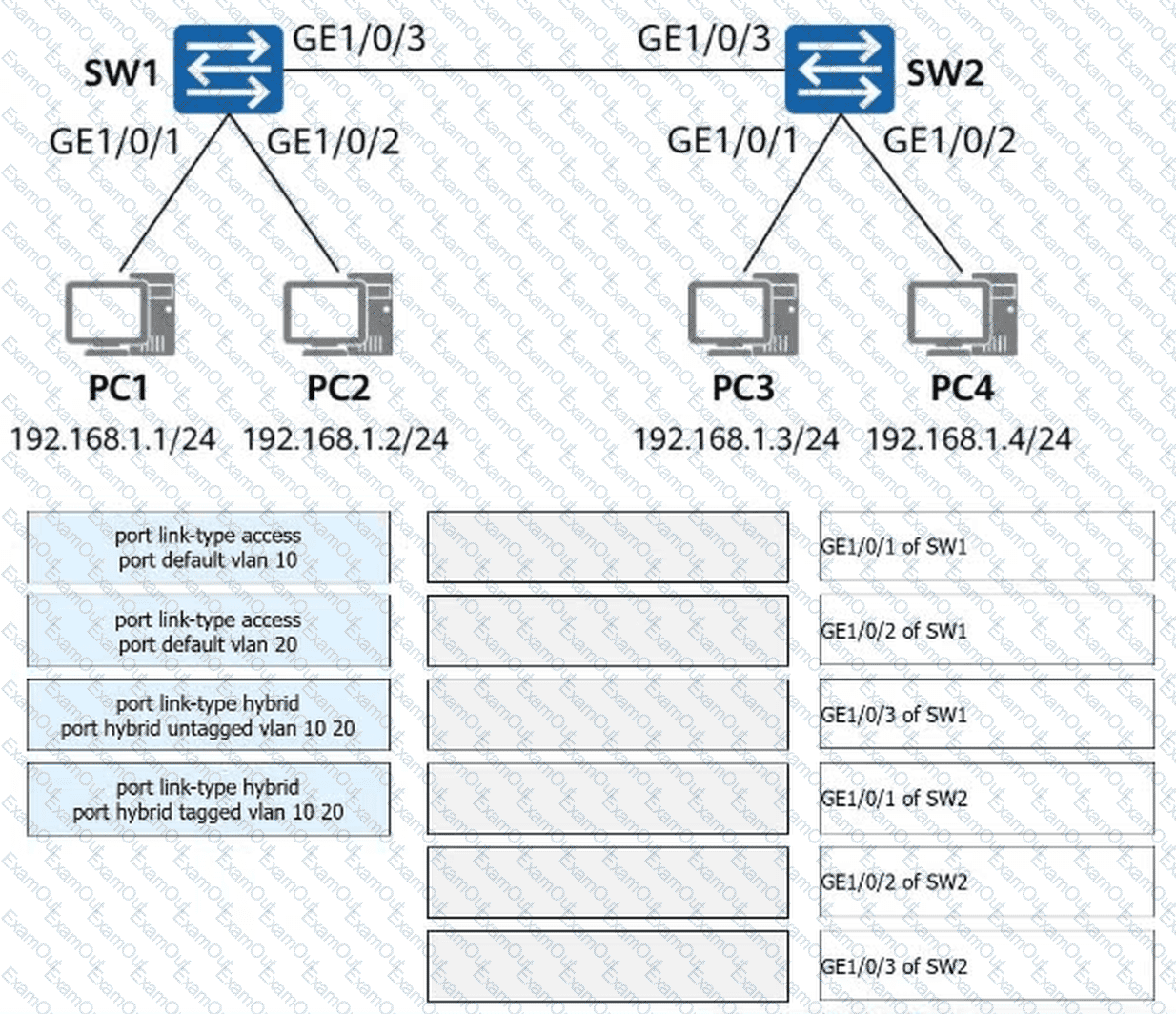
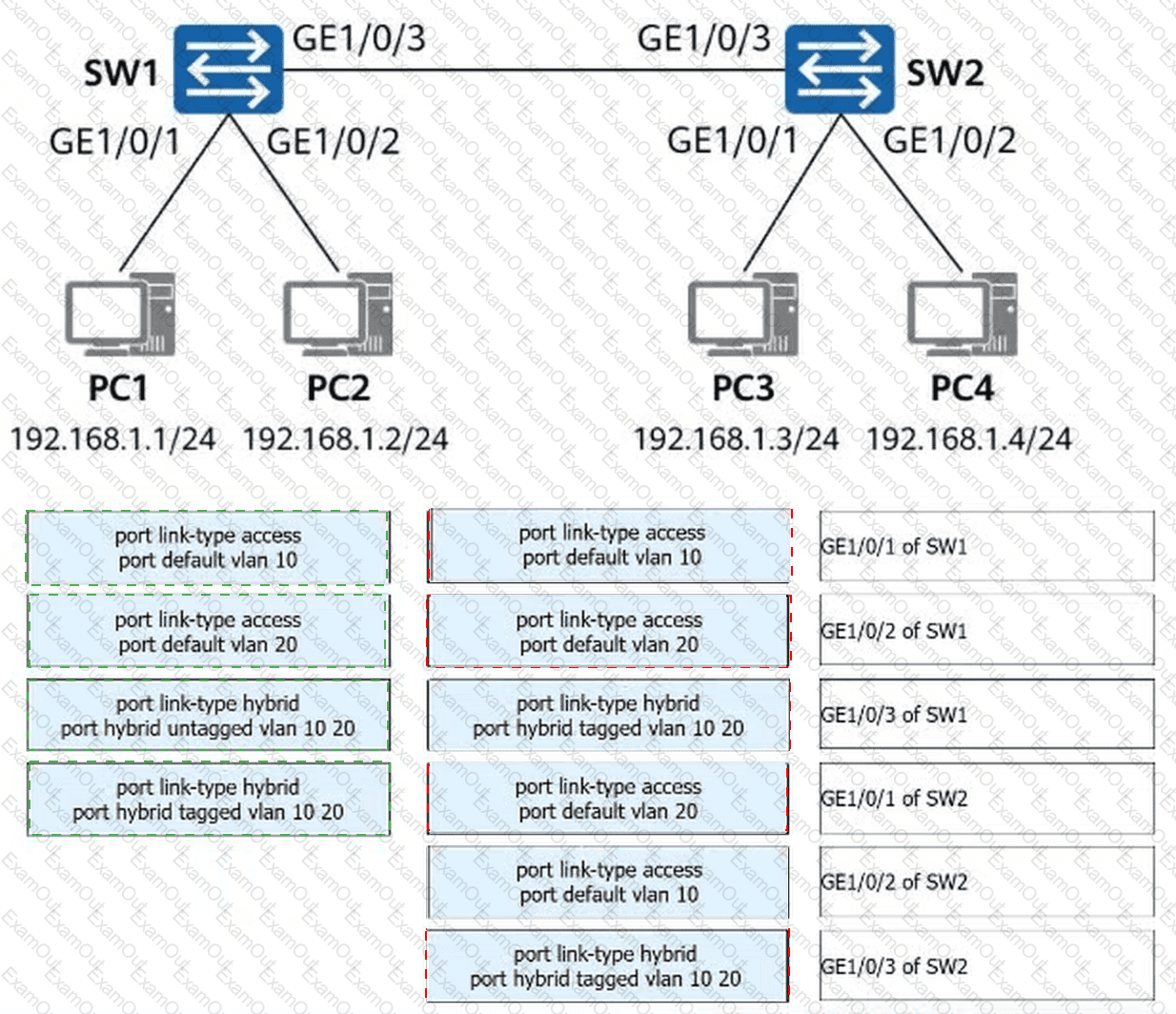
On the network shown in the figure, PC1 and PC4 belong to VLAN 10, and PC2 and PC3 belong to VLAN 20. The administrator has configured the vlan batch 10 20 command on both switches.
To enable Layer 2 communication between PCs in the same VLAN and isolate services between VLANs, match the following interface configurations with interfaces. (Tokens can be reused.)
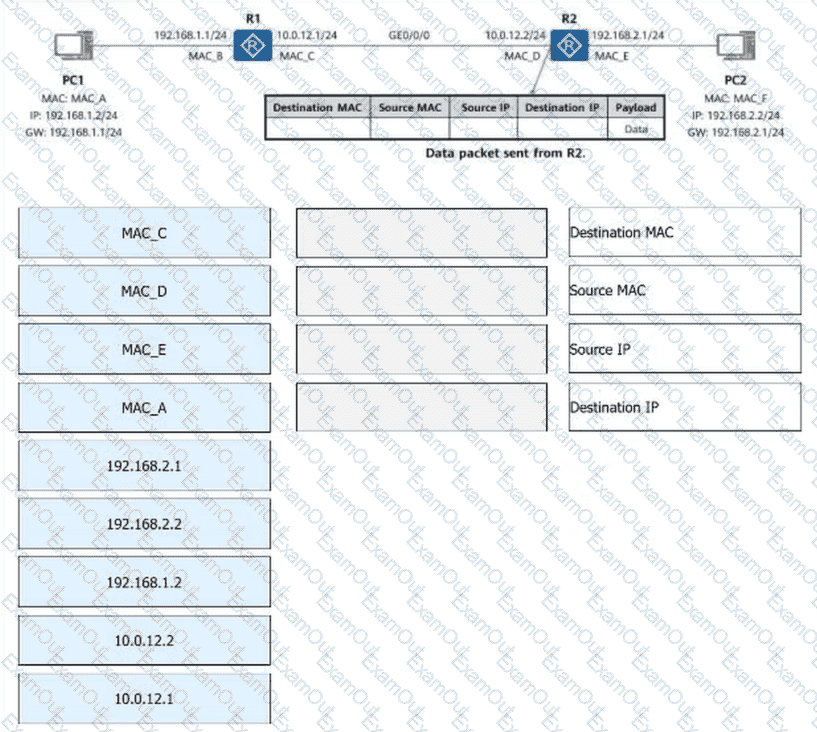
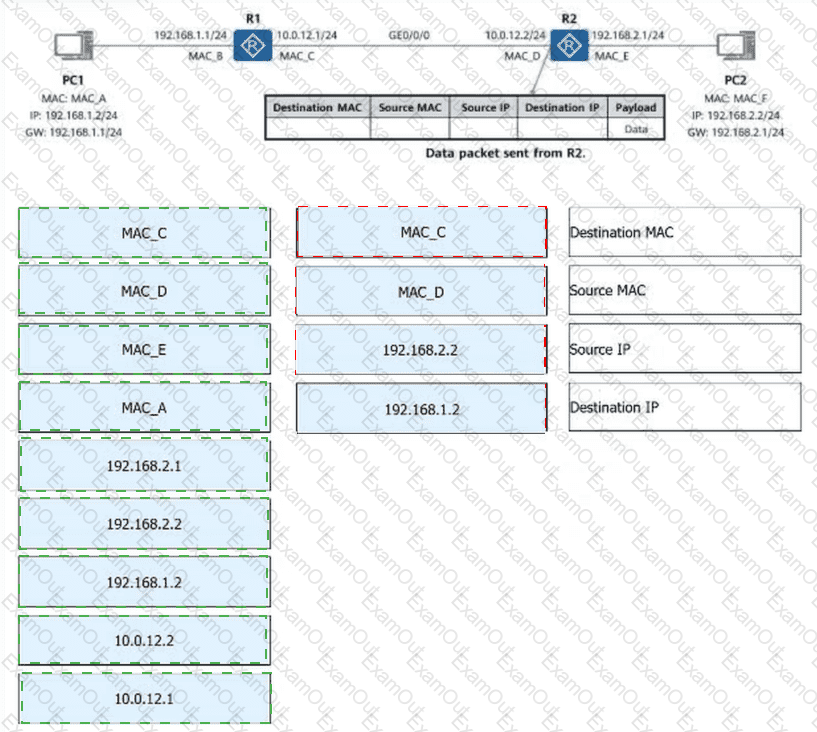
Assume that PC1 and PC2 can communicate with each other, and R2 receives a data packet sent by PC2 to PC1. Match each field in the packet with its correct value by dragging the options to the corresponding fields.
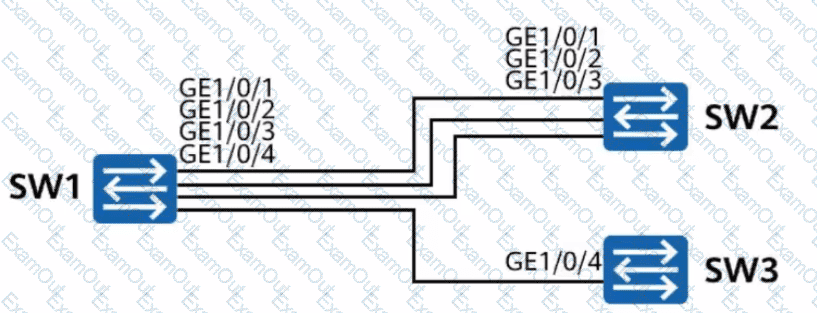
On the network shown in the figure, GE1/0/1, GE1/0/2, and GE1/0/3 of SW1 are directly connected to SW2, and GE1/0/4 of SW1 is directly connected to SW3. The administrator runs the interface eth-trunk 1 command on SW1 and SW2 to create an Eth-Trunk to increase link bandwidth. Which of the following statements are true about this scenario?
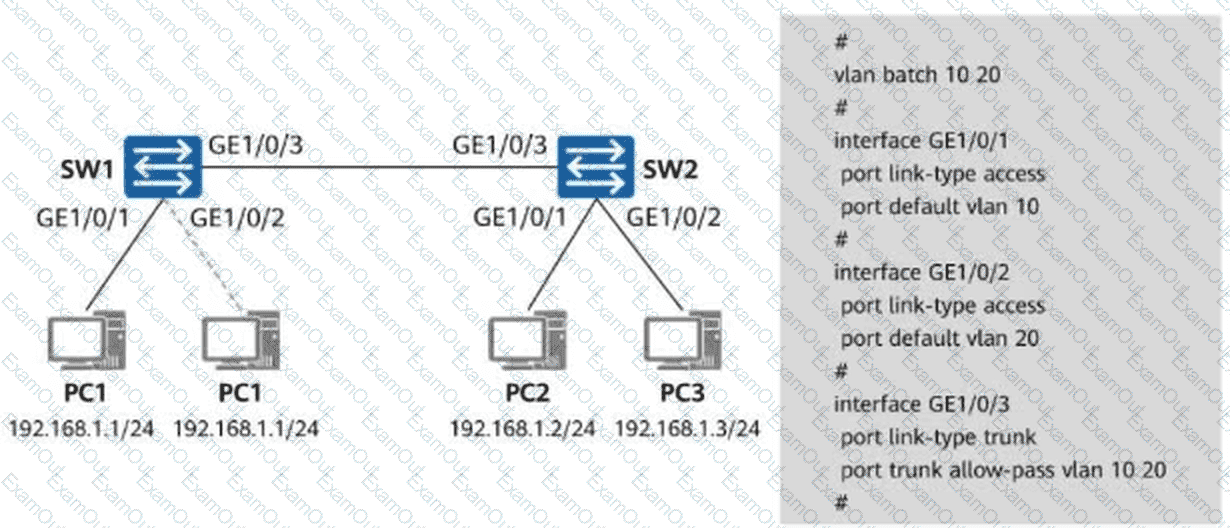
The administrator performs the configuration shown in the figure on SW1 and SW2. Initially, PC1 is connected to GE1/0/1 of SW1. After the network is stable, the administrator pings the IP addresses of PC2 and PC3 from PC1.
Later, the administrator connects PC1 to GE1/0/2 of SW1. After the network is stable, the administrator pings the IP addresses of PC2 and PC3 from PC1.
Which of the following statements is false about this scenario? (Select all that apply)
If host A wants to communicate with host B, which is on another subnet, host A broadcasts an ARP request to obtain host B ' s MAC address. After receiving the request, host B replies with an ARP response to notify host A of its MAC address.
Compared with Wi-Fi 6, Wi-Fi 7 uses which of the following technologies to improve performance?
Unlike distance-vector routing protocols, link-state routing protocols advertise link states instead of route information. Typical link-state routing protocols include RIP, OSPF, and IS-IS.
With the release of Wi-Fi 7, wireless networks are now faster, more stable, and more latency-tolerant than ever. Which of the following frequency bands are supported by Wi-Fi 7? (Select all that apply)
An enterprise has a small amount of wireless user traffic, and all user gateways are located on the core switch. To ensure WLAN security, the customer wants to manage wireless user traffic uniformly on the WAC and requires that the WAC does not carry any wired user traffic. Which of the following WLAN networking methods can the customer choose?