In the WAC + Fit AP networking, an AP fails to go online. The output of the display ap all command run on the WAC is shown below. According to the command output, which of the following is the possible cause of the AP’s failure to go online?

R1 has two equal-cost routes to 10.0.12.0/24 after the following commands are configured.
[R1] ip route-static 10.0.12.0 24 10.0.12.2 preference 60
[R1] ip route-static 10.0.12.0 24 10.0.21.2 preference 60

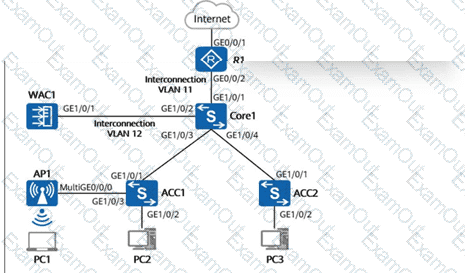
On the campus network shown in the figure below, the core switch Core1 functions as a Layer 3 gateway and as a DHCP server to dynamically assign IP addresses to AP1, PC1, PC2, and PC3. The network below Core1 is a Layer 2 network. WAC1 and R1 are connected to Core1 at Layer 3. AP1 goes online through VLAN 100. The wireless service VLAN is VLAN 101, and the wired service VLANs for PC2 and PC3 are VLAN 102 and VLAN 103, respectively. Additionally, the direct forwarding mode is used for wireless traffic forwarding. If no additional VLANs are allowed on device interfaces, which of the following VLANs must be allowed on GE1/0/1 of ACC1? (Select all that apply)
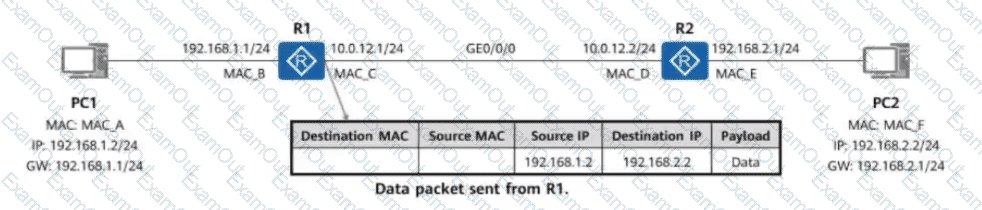
Assume that PC1 and PC2 can communicate with each other. When R1 forwards a data packet sent from PC1 to PC2, which of the following statements are true?
Assume you are an administrator of a campus network. You want to enable STelnet on network devices so that you can remotely log in to them for service commissioning and configuration changes. Which of the following statements is false about STelnet?
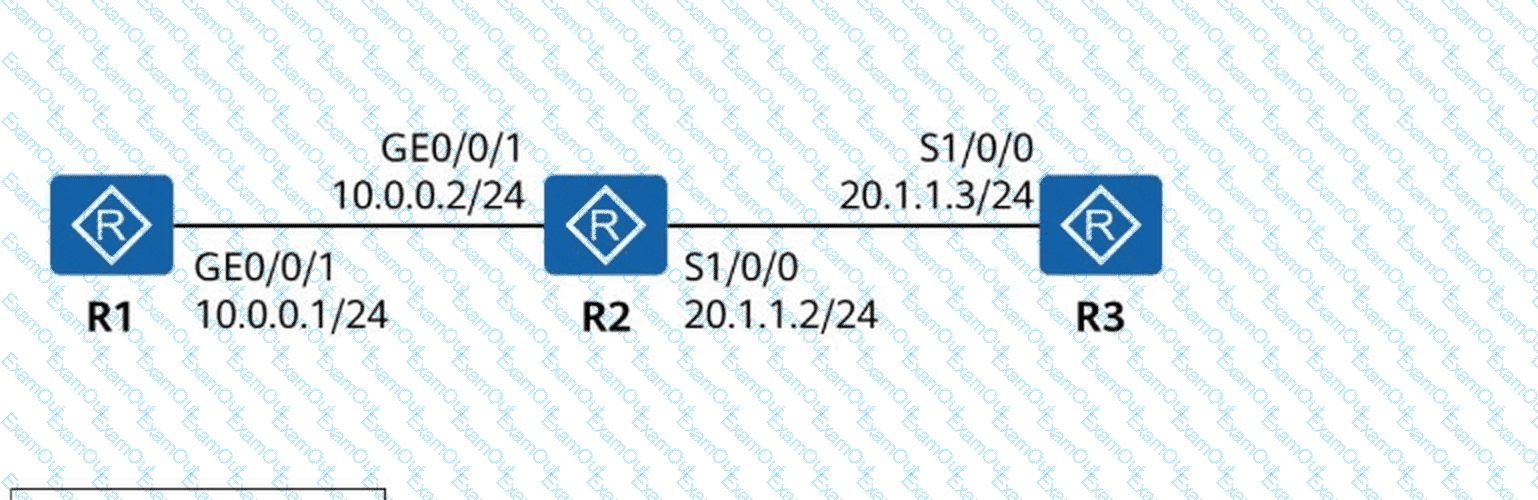
On the network shown in the figure, it is required that interfaces on R1 and R3 are reachable to each other through static routes. When implementing this requirement, there is no need to configure static routes on _____. (Enter a device name in the figure, for example, R1.)
Rl has the following configurations:
[R1] aaa
[R1-aaa] authentication-scheme auth1
[R1-aaa-authen-authl] authentication-mode radius local
[R1-aaa-authen-authl] quit
According to the preceding information. Assume that R1 is properly connected to the RADIUS server. When a user accesses R1, R1 first performs RADIUS
authentication on the user. If the RADIUS server sends an authentication failure message to R1, R1 then performs local authentication on the user.
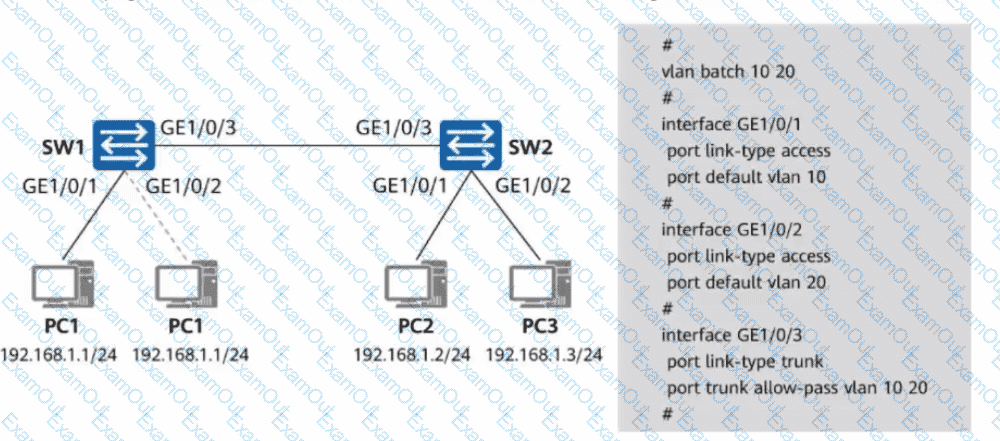
The administrator performs the configuration shown in the figure on SW1 and SW2. Initially, PC1 is connected to GE1/0/1 of SW1. After the network is stable, the administrator pings the IP addresses of PC2 and PC3 from PC1. Later, the administrator connects PC1 to GE1/0/2 of SW1. After the network is stable, the administrator pings the IP addresses of PC2 and PC3 from PC1. Which of the following statements is false about this scenario?
PC1 and PC2 are connected to the same switch, but they cannot learn each other’s ARP information. This may be caused by incorrect VLAN configuration on the switch.
On a campus network, if two switches are directly connected through three physical links, you can configure either STP or link aggregation to improve network reliability. These two functions are mutually exclusive, meaning only one of them can be configured on a device at a time.