You ' re building a CI/CD (continuous integration/continuous delivery) pipeline and need to inject sensitive variables into your Terraform run. How can you do this safely?
You have to initialize a Terraform backend before it can be configured.
You just upgraded the version of a provider in an existing Terraform project. What do you need to do to install the new provider?
A provider configuration block is required in every Terraform configuration.
Example:
Which syntax check returns an error when you run terraform validate?
One remote backend configuration always maps to a single remote workspace.
You ' ve used Terraform to deploy a virtual machine and a database. You want to replace this virtual machine instance with an identical one without affecting the database. What is the best way to achieve this using Terraform?
You have declared a variable called var.list which is a list of objects that all have an attribute id . Which options will produce a list of the IDs? Choose two correct answers.
A developer accidentally launched a VM (virtual machine) outside of the Terraform workflow and ended up with two servers with the same name. They don ' t know which VM Terraform manages but do have a list of all active VM IDs.
Which of the following methods could you use to discover which instance Terraform manages?
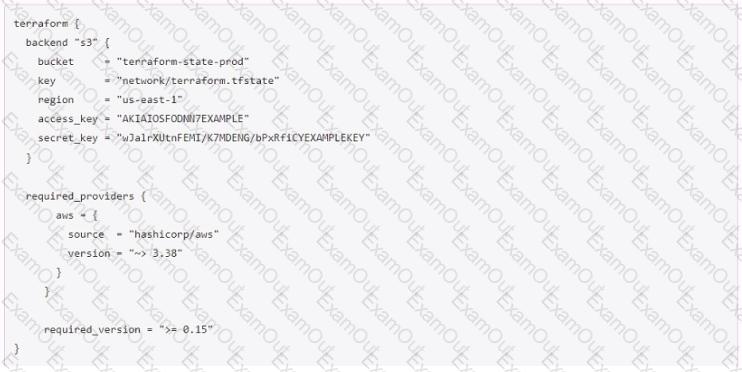
Why does this backend configuration not follow best practices?