An administrator adds local administrative accounts to manage the Aruba Mobility Controllers (MCs). Which role should the administrator assign to an administrator who should have the same privileges as the default admin account?
What is true about clustering and AP connections to cluster members?
An administrator creates a User Rule for role derivation on the Mobility Master (MM). Which client information can an administrator specify to identify that a particular user should be assigned a different role from the initial role?
An administrator defines credentials in the Mobility Master> Configuration> System section to configure a Mobility Master (MM). The administrator then accesses AirWave and adds the MM in Monitor-Only mode. The administrator expects AirWave to automatically discover the Aruba Virtual Mobility Controllers (VMCs) also managed by the MM, but does not see these under APs/Devices> New section in AirWave.
What should the administrator do to solve this problem?
An administrator deploys a RAP at a branch office. The RAP should send all employee corporate traffic to the Mobility Controller (MC) and Internet traffic should stay local.
Which forwarding mode should the administrator configure for the employee WLAN to allow for this forwarding?
Refer to the exhibit.
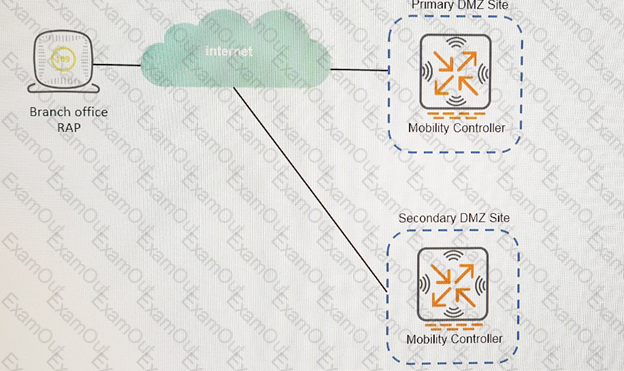
An administrator supports a RAP at a branch office shown in the exhibit. The company has one Mobility Controller (MC) at the Primary DMZ site and one at the Secondary DMZ site. The RAP is configured to connect to only the MC at the Primary DMZ site. A network outage with the ISP at the Primary DMZ site causes the RAP to reboot. Upon reboot, the RAP cannot build a tunnel to the Secondary DMZ site MC because the administrator forgot to add the Second LMS IP address to the AP Group configuration. Once the RAP can successfully connect, the administrator can add the Secondary DMZ MC as a backup LMS to fix the AP Group.
What should the administrator implement to allow the RAP to connect to the MC at the Secondary DMZ site while the outage at the primary site persists?
Refer to the exhibit.
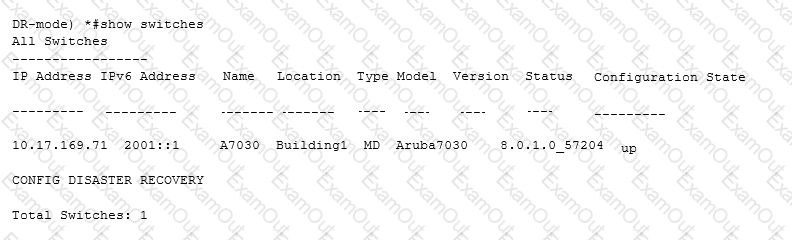
What is true about the operation of the Aruba Mobility Controller (MC) shown in the exhibit?
Refer to the exhibit.
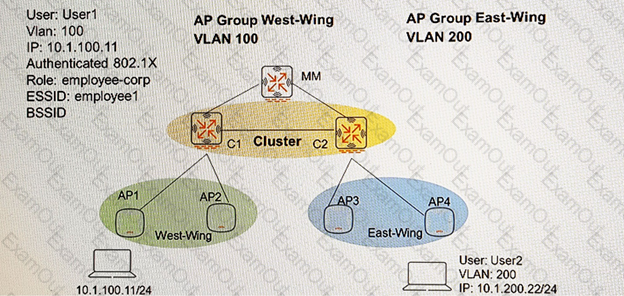
Controllers are configured in a cluster as shown in the exhibit. These are the network details.
-A Mobility Master (MM) managers the cluster.
-The cluster contains two controllers: C1 and C2.
-AP1 and AP2 use C1 as their Active AP Anchor Controller (A-AAC), with C2 as their Standby AAC (S-AAC).
-AP3 and AP4 use C2 as their A-AAC with, C1 as their S-AAC.
User1 establishes a wireless connection via AP1, where the Active User Controller (U-UAC) assigned is C1, with C2 as the standby. What happens when User1 roams the wireless network and eventually their session is handled by AP3?
Which VPN component must be configured on the Mobility Master (MM) to allow a RAP to use the built-in certificate to successfully connect to a Mobility Controller (MC)?
An administrator supports an Aruba wireless solution that uses ClearPass to implement server role assignment. A user reports that they are not able to access the correct department resources. The administrator determines from the connected controller that the user is associated to the login user profile instead of the department user profile.
What should the administrator examine on the ClearPass server to determine the Aruba VSA User Role value that ClearPass returns to the controller?