One of your models is trained using data provided by a third-party data broker. The data broker does not reliably notify you of formatting changes in the data. You want to make your model training pipeline more robust to issues like this. What should you do?
You work for a biotech startup that is experimenting with deep learning ML models based on properties of biological organisms. Your team frequently works on early-stage experiments with new architectures of ML models, and writes custom TensorFlow ops in C++. You train your models on large datasets and large batch sizes. Your typical batch size has 1024 examples, and each example is about 1 MB in size. The average size of a network with all weights and embeddings is 20 GB. What hardware should you choose for your models?
You work for an auto insurance company. You are preparing a proof-of-concept ML application that uses images of damaged vehicles to infer damaged parts Your team has assembled a set of annotated images from damage claim documents in the company ' s database The annotations associated with each image consist of a bounding box for each identified damaged part and the part name. You have been given a sufficient budget to tram models on Google Cloud You need to quickly create an initial model What should you do?
You have a demand forecasting pipeline in production that uses Dataflow to preprocess raw data prior to model training and prediction. During preprocessing, you employ Z-score normalization on data stored in BigQuery and write it back to BigQuery. New training data is added every week. You want to make the process more efficient by minimizing computation time and manual intervention. What should you do?
You work on a data science team at a bank and are creating an ML model to predict loan default risk. You have collected and cleaned hundreds of millions of records worth of training data in a BigQuery table, and you now want to develop and compare multiple models on this data using TensorFlow and Vertex AI. You want to minimize any bottlenecks during the data ingestion state while considering scalability. What should you do?
Your team is working on an NLP research project to predict political affiliation of authors based on articles they have written. You have a large training dataset that is structured like this:
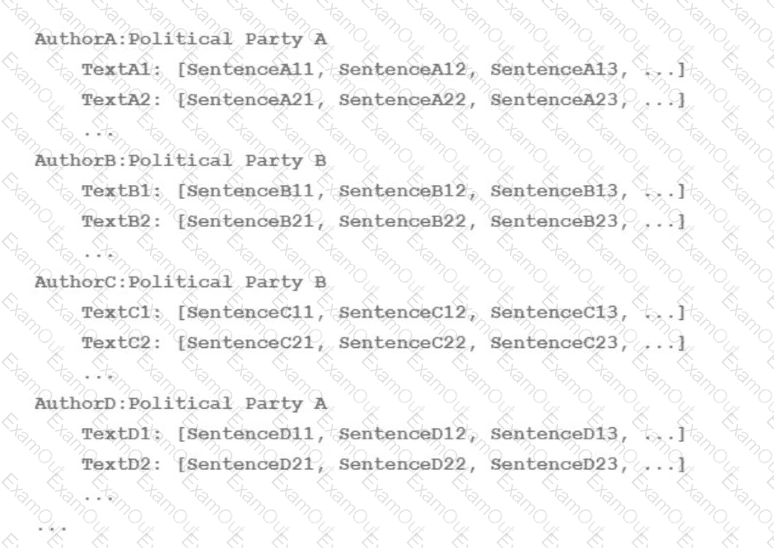
You followed the standard 80%-10%-10% data distribution across the training, testing, and evaluation subsets. How should you distribute the training examples across the train-test-eval subsets while maintaining the 80-10-10 proportion?
A)
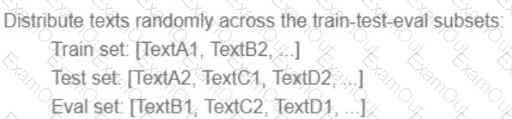
B)

C)

D)

You are the Director of Data Science at a large company, and your Data Science team has recently begun using the Kubeflow Pipelines SDK to orchestrate their training pipelines. Your team is struggling to integrate their custom Python code into the Kubeflow Pipelines SDK. How should you instruct them to proceed in order to quickly integrate their code with the Kubeflow Pipelines SDK?