Month End Sale Special - Limited Time 70% Discount Offer - Ends in 0d 00h 00m 00s - Coupon code: sntaclus

(You want to configure two static routes: one that references an SD-WAN zone and a second one that references an SD-WAN member that belongs to that zone.

Which statement about this scenario is true? Choose one answer.)

A.

You cannot create static routes for individual SD-WAN members.

B.

You cannot create static routes that reference an SD-WAN zone.

C.

The destination subnets must be different.

D.

The source subnets must be different.

(Refer to the exhibit.
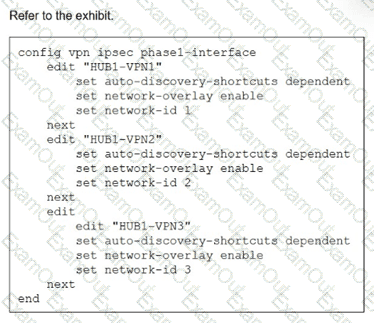
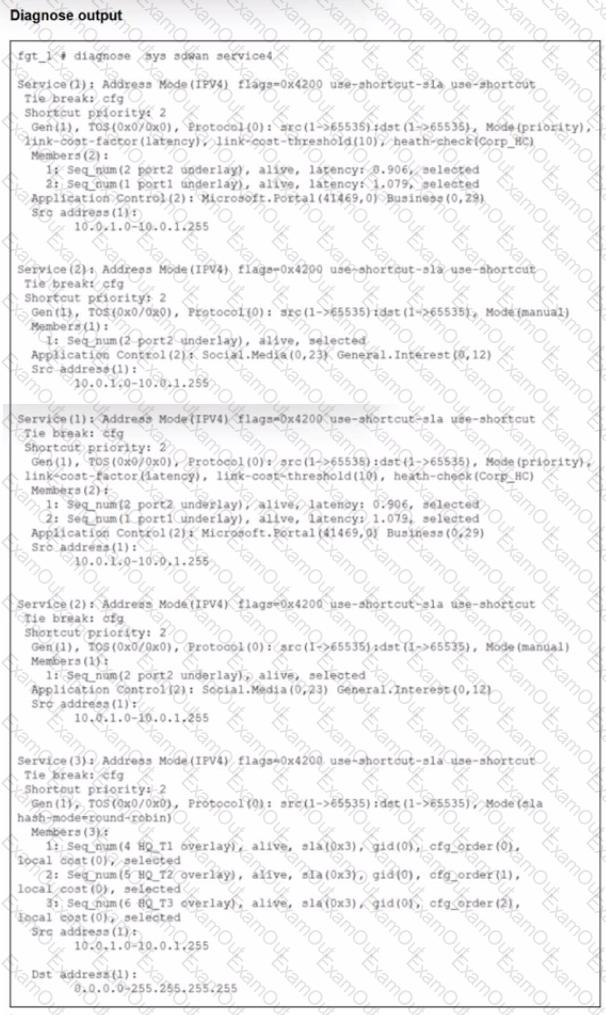
Based on the output shown in the exhibit, what can you conclude about the device role and how it handles health checks? Choose one answer.)

A.

The device is a spoke and it provides embedded health-check measures for each tunnel to the hub.

B.

The device is a spoke and it receives health-check measures for the tunnels of another spoke.

C.

The device is a hub and it receives embedded health-check measures for each tunnel from the spoke.

D.

The device is a hub and it receives health-check measures for the tunnels of a spoke.

The SD-WAN overlay template helps to prepare SD-WAN deployments. To complete the tasks performed by the SD-WAN overlay template, the administrator must perform some post-run tasks. What are two mandatory post-run tasks that must be performed? (Choose two.)

A.

Configure routing through the overlay tunnels created by the SD-WAN overlay template.

B.

Create policy packages and assign them to the branch devices.

C.

Assign a hub id metadata variable to each hub device.

D.

Configure SD-WAN rules

E.

Assign an sdwan_id metadata variable to each device (branch and hub)

(In the context of SD-WAN, the terms underlay and overlay are commonly used to categorize links.

Which two statements about underlay and overlay links are correct? Choose two answers.)

A.

A VLAN is a type of overlay link.

B.

Overlay links provide routing flexibility.

C.

FortiLink interface is considered an underlay link.

D.

Wireless connections can be used to build overlay links.

E.

Only wired connections can be used as underlay links.

(Which two features must you configure before FortiGate can steer traffic according to SD-WAN rules? Choose two answers.)

A.

Security profiles

B.

Underlay links

C.

Overlay links

D.

Traffic shaping

E.

Firewall policies

Refer to the exhibits.

The first exhibit shows the SD-WAN zone HUB1 and SD-WAN member configuration from an SD-WAN template, and the second exhibit shows the output of command diagnose sys sdwan member collected on a FortiGate device.

Which statement best describes what the diagnose output shows?

A.

The diagnose output shows that HUB1-VPN1 and all HUBx-VPNy members are dead.

B.

The diagnose output does not correspond to a device configured with the SD-WAN template shown in the exhibit.

C.

The diagnose output was collected on the device branch2_fgt.

D.

The diagnose output was collected on the device branch1_fgt

Refer to the exhibits.

The administrator configured a device blueprint and CLI scripts as shown in the exhibits, to prepare for onboarding FortiGate devices in the company’s stores. Later, a technician prepares a FortiGate 51G with a basic configuration and connects it to the network. The basic configuration contains the port1 configuration and the minimal configuration required to allow the device to connect to FortiManager.

After the device first connects to FortiManager, FortiManager updates the device configuration.

Based on the exhibits, which actions does FortiManager perform?

A.

FortiManager updates the device configuration according to the selected templates. It applies the corp_st template first.

B.

FortiManager does not update the port1 configuration because FortiManager does not change the configuration of interfaces with fgfm access.

C.

FortiManager updates access rights only for port1. FortiManager cannot update the IP address because it was already set manually.

D.

FortiManager updates the configuration of port1, port2, and port5. The three ports might get new IP addresses.

(Refer to the exhibits.

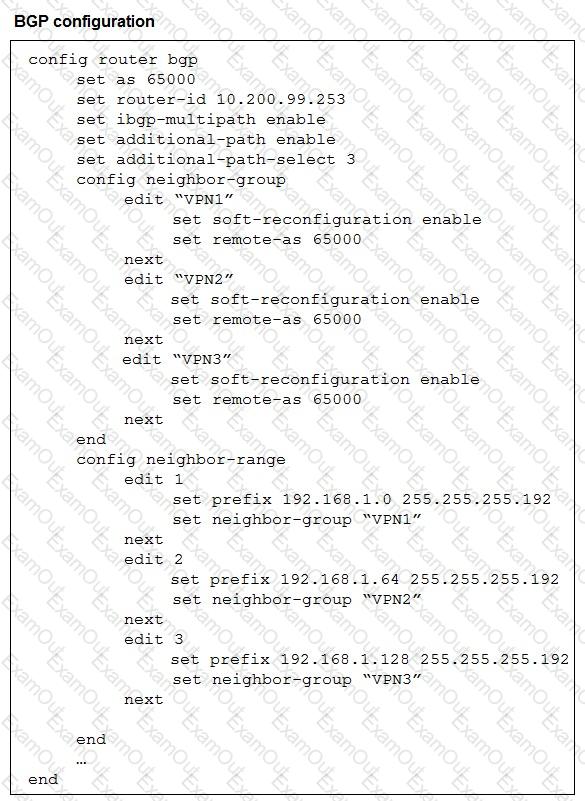
The SD-WAN overlay template advanced settings and the underlay and network advertisement settings are shown. These are the configurations for the secondary hub of a dual-hub SD-WAN topology created with the FortiManager SD-WAN overlay orchestrator.

Which two conclusions can you draw from the information shown in the exhibits? Choose two answers.)

A.

FortiManager will define port2 as a BGP neighbor.

B.

FortiManager will create an overlay tunnel on the port2 interface.

C.

FortiManager will create an overlay tunnel on the port1 interface.

D.

FortiManager will define port5 as a BGP neighbor.

Refer to the exhibit.

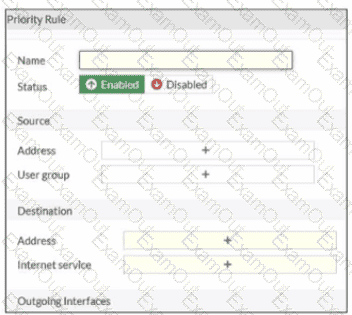
An administrator configures SD-WAN rules for a DIA setup using the FortiGate GUI. The page to configure the source and destination part of the rule looks as shown in the exhibit. The GUI page shows no option to configure an application as the destination of the SD-WAN rule Why?

A.

You cannot use applications as the destination when FortiGate is used for a DIA setup.

B.

FortiGate allows the configuration of applications as the destination of SD-WAN rules only on the CLI.

C.

You must enable the feature on the CLI.

D.

You must enable the feature first using the GUI menu System > Feature Visibility.

An administrator is configuring SD-WAN to load balance their network traffic. Which two things should they consider when setting up SD-WAN? (Choose two.)

A.

You can select the outbandwidth hash mode with all strategies that allow load balancing.

B.

Only the manual and best-quality strategies allow SD-WAN load balancing.

C.

When applicable. FortiGate load balances the traffic through all members that meet the SLA target.

D.

SD-WAN load balancing is possible only using the best quality and lowest cost (SLA) strategies.