Pre-Summer Sale Special - Limited Time 70% Discount Offer - Ends in 0d 00h 00m 00s - Coupon code: sntaclus

Refer to the exhibit.

A pre-run CLI template that is used in zero-touch provisioning (ZTP) and low-touch provisioning (LTP) with FortiManager is shown.
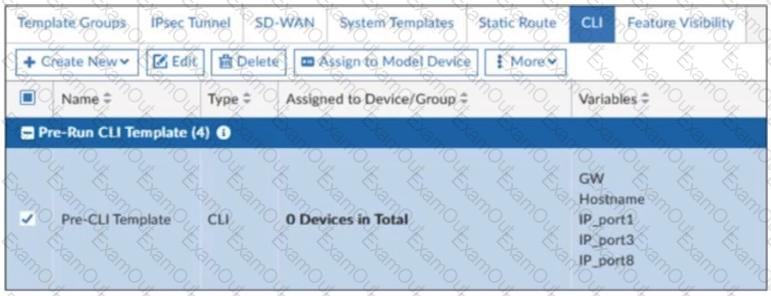
The template is not assigned even though the configuration has already been installed on FortiGate.

What is true about this scenario?

A.

The administrator did not assign the template correctly when adding the model device because pre-CLI templates remain permanently assigned to the firewall

B.

Pre-run CLI templates are automatically unassigned after their initial installation

C.

Pre-run CLI templates for ZTP and LTP must be unassigned manually after the first installation to avoid conflicting error objects when importing a policy package

D.

The administrator must use post-run CLI templates that are designed for ZTP and LTP

An administrator received a FortiAnalyzer alert that a 1 ТВ disk filled up in a day. Upon investigation, they found thousands of unusual DNS log requests, such as JHCMQK.website.com, with no answers. They later discovered that DNS exfiltration was occurring through both UDP and TLS.

How can the administrator prevent this data theft technique?

A.

Create an inline-CASB to protect against DNS exfiltration.

B.

Configure a File Filter profile to prevent DNS exfiltration.

C.

Enable DNS Filter to protect against DNS exfiltration.

D.

Use an IPS profile and DNS exfiltration-related signatures.

An administrator applied a block-all IPS profile for client and server targets to secure the server, but the database team reported the application stopped working immediately after.

How can an administrator apply IPS in a way that ensures it does not disrupt existing applications in the network?

A.

Use an IPS profile with all signatures in monitor mode and verify patterns before blocking.

B.

Limit the IPS profile to server targets only to avoid blocking connections from the server to clients.

C.

Select flow mode in the IPS profile to accurately analyze application patterns.

D.

Set the IPS profile signature action to default to discard all possible false positives.

How do you resolve object conflicts when importing a policy package?

A.

Rename

B.

FortiManager accept

C.

Non-default

D.

Retrieve config

Why does FortiGate_B install only one OSPF external route?

A.

ECMP disabled

B.

Single advertisement

C.

Area mismatch

D.

Route filtering

Refer to the exhibits.

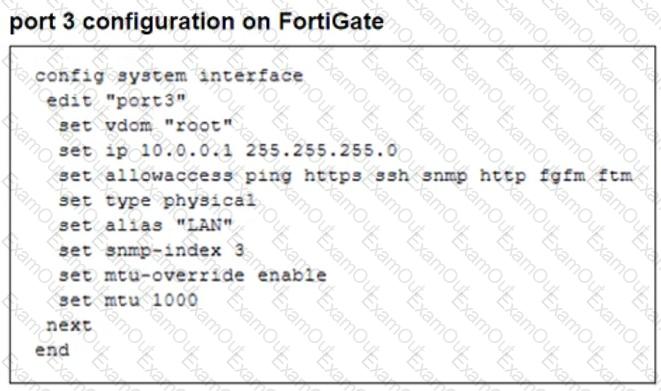
The configuration of a user ' s Windows PC, which has a default MTU of 1500 bytes, along with FortiGate interfaces set to an MTU of 1000 bytes, and the results of PC1 pinging server 172.16.0.254 are shown.

Why is the user in Windows PC1 unable to ping server 172.16.0.254 and is seeing the message: Packet needs to be fragmented but DF set?

A.

Option ip.flags.mf must be set to enable on FortiGate. The user has to adjust the ping MTU to 1000 to succeed.

B.

Fragmented packets must be encrypted. To connect any application successfully, the user must install the Fortinet_CA certificate in the Microsoft Management Console.

C.

FortiGate honors the do not fragment bit and the packets are dropped. The user has to adjust the ping MTU to 972 to succeed.

D.

The user must trigger different traffic because path MTU discovery techniques do not recognize ICMP payloads.

What does npu_flag=20 indicate for IPsec tunnels?

A.

Inbound only

B.

Outbound only

C.

Both SAs

D.

No offload

What can be inferred from the OSPF status output shown?

A.

Is ASBR

B.

Is BDR

C.

Supports ECMP

D.

Is in area 0.0.0.5

Which hardware improves VXLAN performance?

A.

CPU

B.

NTurbo

C.

CP10

D.

NPU7

A company that acquired multiple branches across different countries needs to install new FortiGate devices on each of those branches. However, the IT staff lacks sufficient knowledge to implement the initial configuration on the FortiGate devices.

Which three approaches can the company take to successfully deploy advanced initial configurations on remote branches? (Choose three.)

A.

Use metadata variables to dynamically assign values according to each FortiGate device.

B.

Use provisioning templates and install configuration settings at the device layer.

C.

Use the Global ADOM to deploy global object configurations to each FortiGate device.

D.

Apply Jinja in the FortiManager scripts for large-scale and advanced deployments.

E.

Add FortiGate devices on FortiManager as model devices, and use ZTP or LTP to connect to FortiGate devices.