A security architect is designing Zero Trust enforcement policies for all end users. The majority of users work remotely and travel frequently for work. Which of the following controls should the security architect do first?
Which of the following best describes the challenges associated with widespread adoption of homomorphic encryption techniques?
A network security architect for an organization with a highly remote workforce implements an always-on VPN to meet business requirements. Which of the following best explains why the architect is using this approach?
A security administrator needs to review the efficacy of the detection rules configured on the SIEM by employing real-world attacker TTPs. Which of the following actions should the security administrator take to accomplish this objective?
Company A acquired Company B. During an audit, a security engineer found Company B ' s environment was inadequately patched. In response, Company A placed a firewall between the two environments until Company B ' s infrastructure could be integrated into Company A ' s security program. Which of the following risk-handling techniques was used?
A systems administrator is working with clients to verify email-based services are performing properly. The administrator wants to have the email server digitally sign outbound emails using the organization ' s private key. Which of the following should the systems administrator configure?
An organization with a remote workforce has a new client with the following requirements:
Consultants need to travel to the client site.
The company has proprietary information on its hard drives.
The company prohibits BYOD.
Which of the following would be the most beneficial for the organization to implement?
An organization purchased a new manufacturing facility and the security administrator needs to:
• Implement security monitoring.
• Protect any non-traditional device(s)/network(s).
• Ensure no downtime for critical systems.
Which of the following strategies best meets these requirements?
A company’s internal network is experiencing a security breach, and the threat actor is still active. Due to business requirements, users in this environment are allowed to utilize multiple machines at the same time. Given the following log snippet:
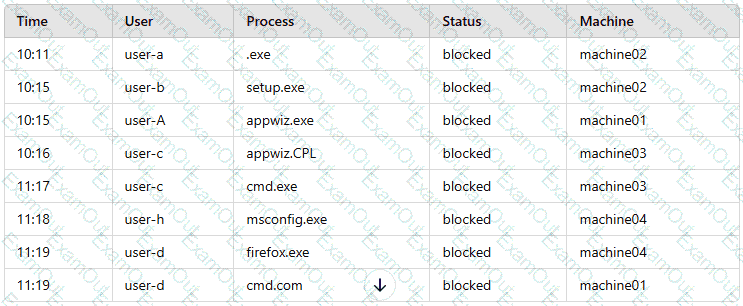
Which of the following accounts should a security analyst disable to best contain the incident without impacting valid users?
An organization recently migrated data to a new file management system. The architect decides to use a discretionary authorization model on the new system. Which of the following best explains the architect ' s choice?