
A security operations analyst is reviewing network traffic baselines for nightly database backups. Given the following information:
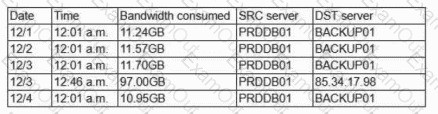
Which of the following should the security analyst do next?
Emails that the marketing department is sending to customers are pomp to the customers ' spam folders. The security team is investigating the issue and discovers that the certificates used by the email server were reissued, but DNS records had not been updated. Which of the following should the security team update in order to fix this issue? (Select three.)
Which of the following best explains the business requirement a healthcare provider fulfills by encrypting patient data at rest?
A company wants to modify its process to comply with privacy requirements after an incident involving PII data in a development environment. In order to perform functionality tests, the QA team still needs to use valid data in the specified format. Which of the following best addresses the risk without impacting the development life cycle?
Employees use their badges to track the number of hours they work. The badge readers cannot be upgraded due to facility constraints. The software for the badge readers uses a legacy platform and requires connectivity to the enterprise resource planning solution. Which of the following is the best to ensure the security of the badge readers?
Due to an infrastructure optimization plan, a company has moved from a unified architecture to a federated architecture divided by region. Long-term employees now have a better experience, but new employees are experiencing major performance issues when traveling between regions. The company is reviewing the following information:
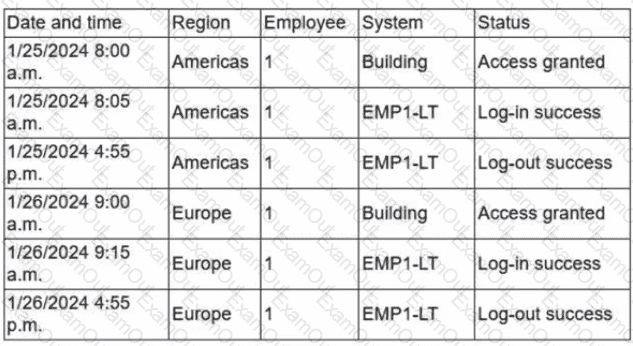
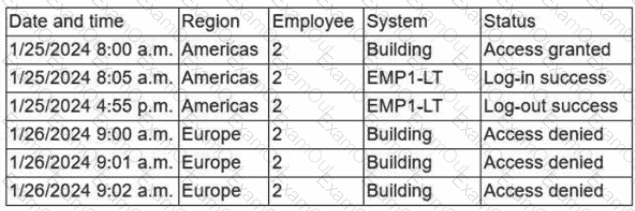
Which of the following is the most effective action to remediate the issue?
A senior security engineer flags the following log file snippet as having likely facilitated an attacker’s lateral movement in a recent breach:
qry_source: 19.27.214.22 TCP/53
qry_dest: 199.105.22.13 TCP/53
qry_type: AXFR
| in comptia.org
------------ directoryserver1 A 10.80.8.10
------------directoryserver2 A 10.80.8.11
------------ directoryserver3 A 10.80.8.12
------------ internal-dns A 10.80.9.1
----------- www-int A 10.80.9.3
------------ fshare A 10.80.9.4
------------ sip A 10.80.9.5
------------ msn-crit-apcs A 10.81.22.33
Which of the following solutions, if implemented, would mitigate the risk of this issue reoccurring?
As part of a security audit in the software development life cycle, a product manager must demonstrate and provide evidence of a complete representation of the code and modules used within the production-deployed application prior to the build. Which of the following best provides the required evidence?
A company has the following requirements for a cloud-based web application:
• Must authenticate customers
• Must prevent data exposure
• Must allow customer access to data throughout the cloud environment
• Must restrict access by specific regions
Which of the following solutions best addresses these security requirements?
Anorganization has noticed an increase in phishing campaigns utilizingtyposquatting. A security analyst needs to enrich the data for commonly used domains against the domains used in phishing campaigns. The analyst uses a log forwarder to forward network logs to the SIEM. Which of the following would allow the security analyst to perform this analysis?
