
A customer plans to adopt distributed QoS in their enterprise WAN. The policy must allow for individual packet marking according to the type of treatment required and for forwarding based on hop-by-hop treatment locally defined on each device. Which technology must the customer select?
Which two techniques improve the application experience in a Cisco SD-WAN design? (Choose two.)
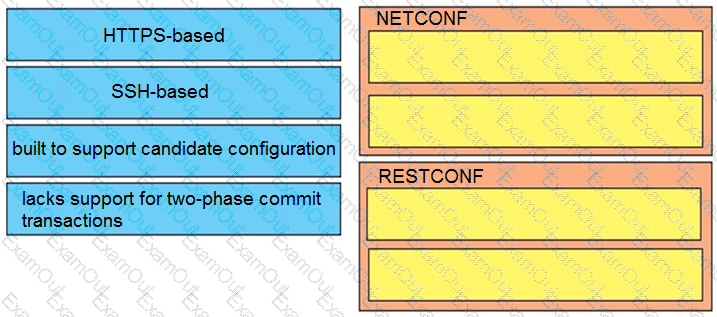
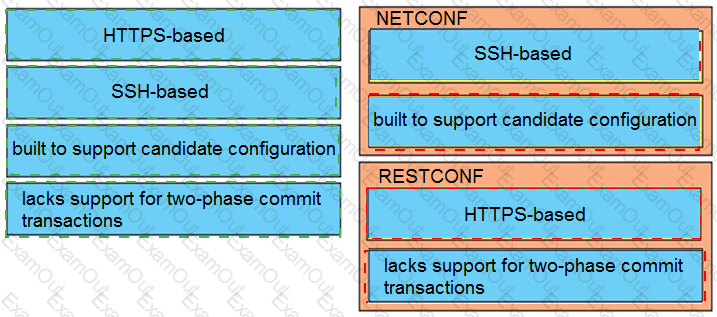
Drag and drop the properties from the left onto the protocols they describe on the right.
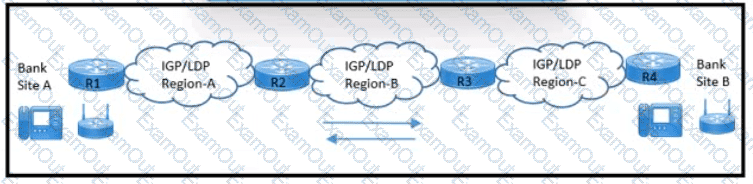
Refer to the exhibit. An architect must design a solution to connect bank site A with bank site B and support:
network operation center monitoring end-to-end L3VPN and L2VPN traffic
company adding thousands of routes in the next two years
Which two BGP solutions must the design include? (Choose two.)
What is the function of the multicast Reverse Path Forwarding check?
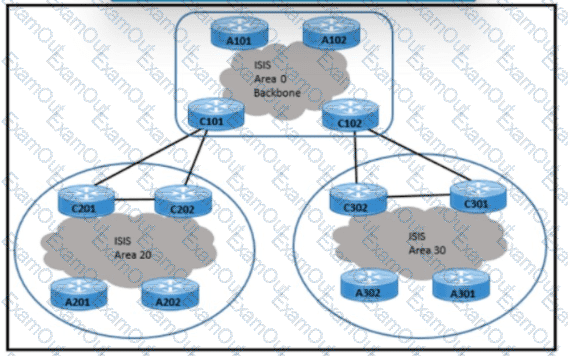
Refer to the exhibit. An architect is designing a hierarchical ISIS solution for a customer with these requirements:
Routers will double In all areas within the next 24 months.
Link flaps within areas 20 and 30 must not impact the backbone area.
Traffic originating from A201 and A302 routers must connect to application servers in the backbone.
Which design must the architect select?
An engineer is creating a design to enable IPv6 to run on an existing IPv4 IS-IS network. The IPv4 and IPv6 topologies will match exactly, and the engineer plans to use the same router levels for each protocol per interface. Which IS-IS design is required?
When is it advisable to provide dedicated control plane nodes within a Cisco SD-Access design?
Refer to the exhibit.
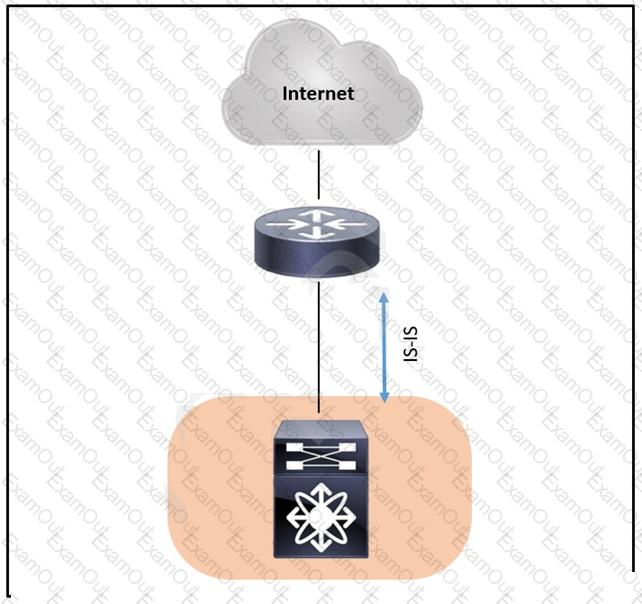
A network engineer must improve the current IS-IS environment. The Catalyst switch is equipped with dual supervisors. Each time a stateful switchover occurs, the network experiences unnecessary route recomputation. Which solution addresses this issue if the upstream router does not understand graceful restart messaging?
Refer to the exhibit.
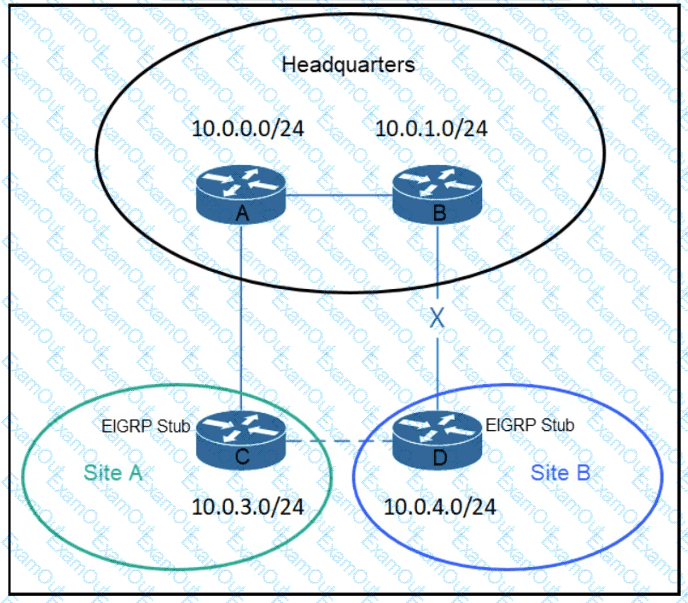
An architect is designing a routing solution for a company. The new design will add a circuit routers C and D to protect against loss of connectivity to 10.0.4.0/24 during a link failure between routers B and D. Which solution must the architect choose?
