Which type of rendezvous point deployment is standards-based and support dynamic RP discovery?
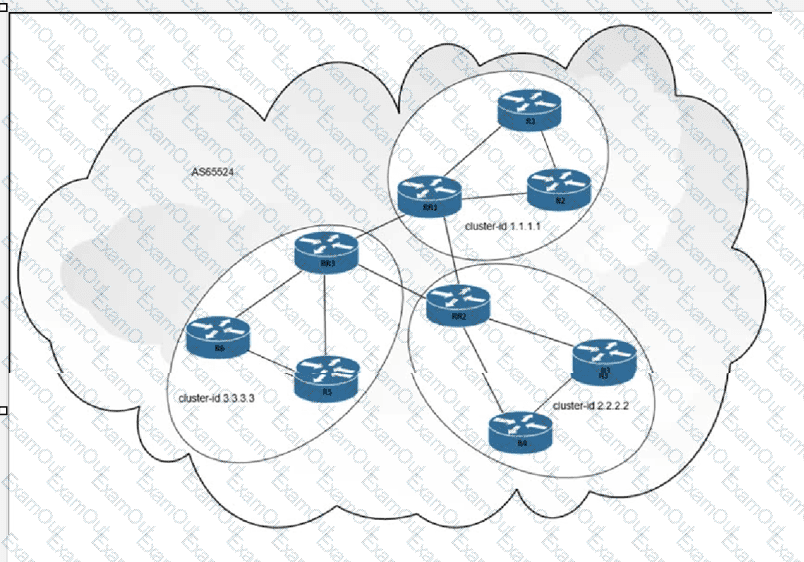
Refer to the exhibit. An architect designed a BGP routing solution to reduce the number of IBGP peerings to conserve resources. The original design had a total of 36 IBGP peerings. The new design reduces the number of peerings by how many?
A network engineer must design a multicast solution based on these requirements:
interactive communication
must not use source trees
users must register
100 multicast sources
Which solution must the company choose?
An engineer must design a multicast network for a financial application. Most of the multicast sources also receive multicast traffic (many-to-many deployment model). To better scale routing tables, the design must not use source trees. Which multicast protocol satisfies these requirements?
Which topology within a network underlay eliminates the need for first hop redundancy protocols while
improving fault tolerance, increasing resiliency, and simplifying the network?
Mobile service provider “A” is going to launch 5G support with the ISP “B” IP network backbone as the underlay transport. Conversational traffic type will be marked with expedited forwarding class, streaming services will be marked with assured forwarding 2 class, and web browsing will be marked with assured forwarding 3 class. Which QoS model meets these requirements if the solution is to be implemented end to end on the ISP_B backbone network?
An engineer is designing a QoS solution for a campus. The design must guarantee real-time traffic delivery during congestion, minimize the bandwidth consumption for possible virus or worm attacks, and reduce flooding of excessive traffic during times of congestion. Which two solutions must the engineer select? (Choose two.)
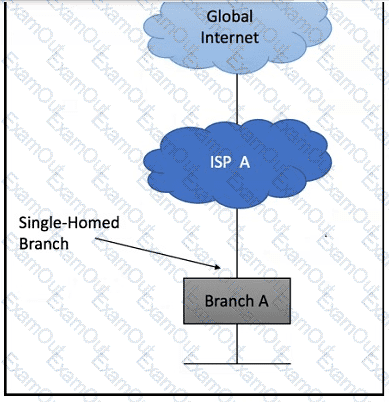
Refer to the exhibit. An architect is designing a BGP solution to connect a remote branch to a service provider. There are several prefixes within the branch that the company does not want to be advertised to the internet. Which solution should the architect use to accomplish this?
An architect must create a QoS solution for a customer to ensure that a 40 Mbps Internet connection is shared between four subnets based on these requirements:
* Each subnet must receive no less than 10 Mbps of download bandwidth during peak traffic times.
* A subnet can use up to 40 Mbps during nonpeak traffic times if the other subnets are idle.
* Download traffic must never experience a delay.
Which solution must the architect choose?
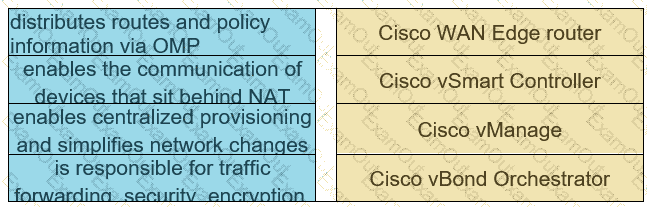
Drag and drop the descriptions from the left onto the Cisco SD-WAN component they describe on the right.