
Spring Sale Special - Limited Time 70% Discount Offer - Ends in 0d 00h 00m 00s - Coupon code: sntaclus

Stalemate is more likely to happen if both parties trade more variables in a commercial negotiation. Is this assumption true?

A.

No, because the party who offers more variables will have lower bargaining power

B.

Yes, because the negotiation will last endlessly if there are too many variables

C.

No, because more variables will facilitate more possible negotiated outcomes

D.

Yes, because more variables will cause more conflicts of interest

A building firm has been awarded a contract to construct an office block. Which is a direct cost?

A.

Cost of materials

B.

Cost of legal fees

C.

Cost of insurance

D.

Cost of office space

Should a buyer use closed questions in a negotiation?

A.

Yes, because closed questions help to reconfirm certain facts

B.

Yes, because they urge the supplier to provide more :

C.

No, the buyer should maximise the use of open questions

D.

No, supplier will consider closed questions as provocation

Maria, an NHS buyer, needs cost savings due to budget cuts. She plans to achieve savings with a collaborative supplier. Which negotiation approach should she use?

A.

Win–Lose

B.

Lose–Lose

C.

Win–Perceived Win

D.

Win–Win

A buyer requests a £2,000 reduction in price at the end of negotiations. The supplier nods and smiles, shakes hands, and leaves. Should the buyer believe the reduced price is agreed?

A.

Yes, the nod and smile indicate agreement

B.

Yes, as that was the last counter-offer so it will stand

C.

No, a non-verbal cue isn’t sufficient to assume agreement

D.

No, at least four verbal cues are required to confirm agreement

The purpose of ongoing supplier relationship management following a negotiation and contract award is that it:

A.

1 and 2 (Enables the buyer to monitor supplier performance and persuade the supplier to renegotiate better terms)

B.

1 and 3 (Enables the buyer to monitor supplier performance and work with the supplier to resolve relationship problems)

C.

3 and 4 (Enables the buyer to work with the supplier to resolve relationship problems and evaluate unnecessary concessions)

D.

2 and 3 (Enables the buyer to persuade the supplier to renegotiate better terms and work with the supplier to resolve relationship problems)

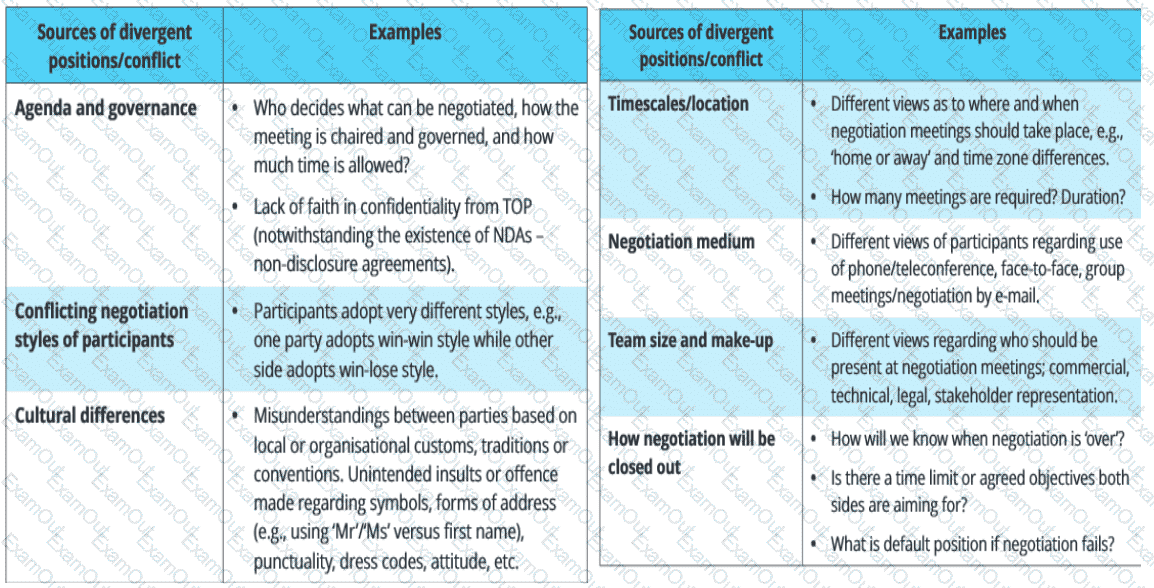
Which of the following are most likely to be sources of conflict that can emerge from the process of commercial negotiations? Select TWO that apply.
A.

Differences in conflict management style

B.

Differences in culture

C.

Types of purchase

D.

Standard terms and conditions

E.

Line of the best fits

Which of the following may help the procurement professional increase expert power in commercial negotiation? Select TWO that apply.

A.

Personality

B.

Official positions

C.

Insights

D.

Ability to compensation

E.

Expertise knowledge

For effective commercial negotiation, an organisation must analyse and apply approaches to negotiate agreements successfully. Which one of the following would provide a successful outcome?

A.

Understand the key approaches to commercial negotiation

B.

Understand the sources of conflict in categories that can arise

C.

Understand the power of stakeholders

D.

Understand the stages of the sourcing process

Which of the following are microeconomic factors? Select THREE that apply.
A.

Rates of taxation

B.

Availability of investors

C.

Unemployment levels

D.

Distribution channels

E.

Rates of inflation

F.

Levels of competition