You're maintaining a client's case management system.
The client needs you to review the performance of one of their interfaces as it is perceived to be quite slow
The interface is a start form that users use to edit party records in the system. They can edit these party records either through the participant view of the case record or directly through the party record.
Given a party record may consist of many attributes, Custom Data Types (CDT) have been used for the purpose of writing to the database, while record types have been used to retrieve data.
What might be a potential cause for this issue, and what should you do?
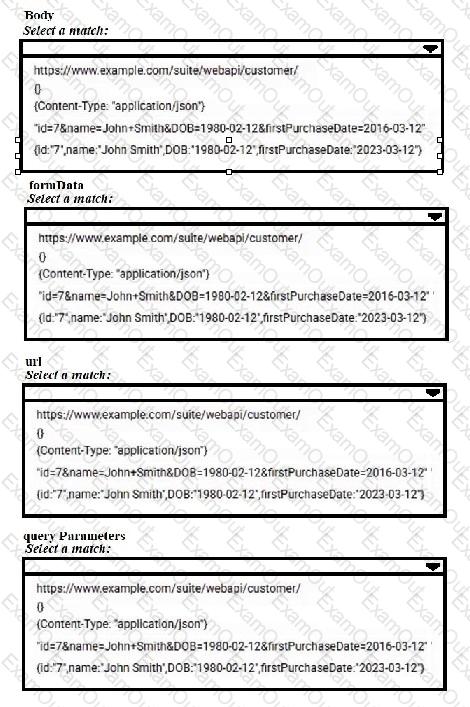
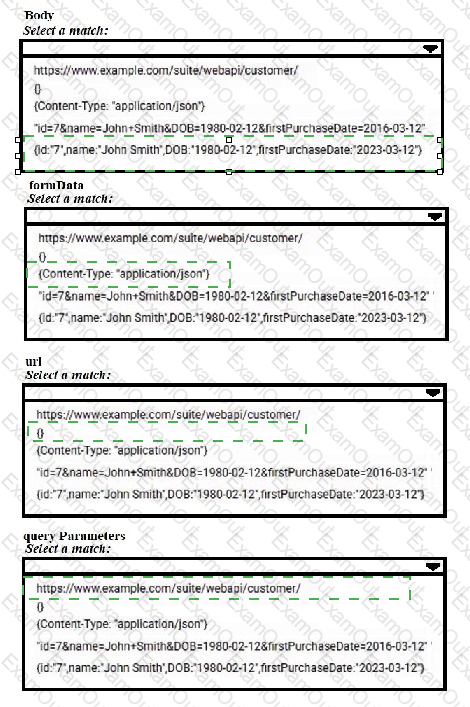
Consider this POST request:
https://www.example.com/suite/webapi/customer
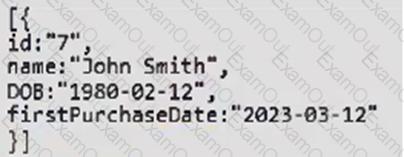
Match the values to the correct fields in the resulting http!request value.
Note: Each value will be used once. To change your responses, you may deselect your response by clicking the blank space at the top of the selection list.
You need to create a process workflow for employee background investigations. This workflow takes an average of six months from start to completion. There are multiple phases to the background investigation which must be completed by people in different departments. Each department is responsible for inputting a large amount of data as part of the workflow.
There is an emphasis on process memory management since thousands of these investigations will happen concurrently.
What are two best practices that you should employ when designing this process workflow? (Choose two.)
You're designing an integration object with JSON (application/json) as the content type.
Which two data types can be automatically converted to JSON in Appian? (Choose two.)
You're refining a story regarding a highly regulated form, where information needs to be sent to a regulatory body at the end of each month to ensure that the business complies with laws and legislation. The story only concerns the creation of the form.
You need to create a form that captures information to comply with the regulatory requirements.
Which two questions should you ask the business? (Choose two.)
You're conducting a code review and notice that some accessibility features are missing on the interfaces.
Which two UX best practices should be followed to align with accessibility requirements? (Choose two.)
An application consists of a record type with sync enabled. This record type is used as a source to create a read-only grid.
A field "Number of days since created" is configured in the interface and a logic is implemented to calculate the number of days since a record is created in the application.
You need to implement sorting on this field.
What should you do?
You need to connect to an external system using OAuth 2.0: SAML Bearer Assertion Flow authentication type, which requests access to an API on behalf of a signed in user.
This standard has the several steps involved with the SAML Bearer Assertion Flow.
Which two steps should you perform? (Choose two.)
You're building an application with a review workflow.
Each submission must be approved by three users who can each approve or reject their request, and leave a comment. This action changes the status of the submission to 'Approved' or 'Rejected' correspondingly, and pushes the review to the previous or next assignee.
Which data model captures the workflow requirements appropriately?
You have designed a three-step 'Wizard' form interaction using user input tasks in the process model. The second step of the Wizard must utilize another process model which contains a user input task inside.
Which two methods should be implemented for a seamless Wizard-like interaction for the user? (Choose two.)