The Westgard multi-rule 22S describes the scenario where two consecutive data points fall outside +2SD or -2SD. If this occurs, then the run must be rejected. This situation is most likely caused by a systematic error.
Which of the following describes the Westgard multi-rule 22S?
Which of the following legislation was developed to protect the privacy of all patient information in the health care?
A positive RPR test and a negative FTA-ABS test is most likely the result of:
Hives and rash usually indicate an allergic reaction. Hematuria is due to a variety of causes. Fever and chills usually indicate a febrile reaction. Positive DAT due to conditions other than sensitization to red cell alloantigens is not uncommon. Therefore a positive DAT in the posttransfusion specimen with a negative DAT in the pretransfusion specimen is more likely to indicate alloimmunization.
The most definite indication that a patient has been sensitized to a specific red cell antigen is:
1+ reaction has numerous small clumps and cloudy red supernatant
2+ has many medium-sized clumps and clear supernatant.
3+ has several large clumps and clear supernatant
4+ has one solid clump, no free cells, and clear supernatant
BB
Tube-based agglutination reactions in blood bank are graded from negative (0) to 4+. A reaction that has numerous small clumps in a cloudy, red background is:
In this case, the pH may become more alkaline, perhaps above 8.0, if the bacteria in the sample are proliferating during the extended room-temperature wait time.
A urine specimen was collected at 6:00 a.m. and remained at room temperature until it was received in the laboratory at 3:30 p.m. How may the pH of the specimen be affected by the extended time at room temperature if bacteria are present in the specimen?
Serum amylase and lipase levels may be slightly elevated in chronic pancreatitis, but not diagnostic enough to predict chronic pancreatitis; wheras high levels are found only during acute pancreatitis episodes. In the later stages of chronic pancreatitis, normal to decreased levels of amylase and lipase are caused by the gradual inability of the pancreas to secrete the enzyme
All of the statements below regarding amylase and lipase in pancreatitis are TRUE EXCEPT:
If your reactions are strong at immediate spin (3+) and then get weaker at AHG (w+), it could mean the presence of a strong cold antibody.
Cold antibodies tend to be IgM and their optimum phase for reactivity is immediate spin. Incubation and washing of the sample may cause the agglutination that occurred at room temperature to break down. This would appear as a weaker reaction at AHG.
If the reaction strengths varied in each panel cell then that could be an indication that there are multiple antibodies present.
Your screen cells are 3+ at immediate spin and weak (W)+ at AHG. Your auto control is negative for both phases. Some of your antibody panel cells are 3+ at immediate spin and negative at AHG. What should you suspect?
Healthcare workers that worked closely with patient specimens were at an increased risk of contracting which viral infection before a vaccine was developed?
The MCV is indicative of microcytosis with MCV=<80fL. The RDW is within normal limits and indicative of a homogenous cell population.
If the MCV was >100 fL, this would be indicative of macrocytosis. An RDW that was outside of normal limits would be indicative of a heterogenous cell population.
An 18 year old female has a CBC as part of a routine physical exam. The following results were obtained and the physician determines she is anemic. After reviewing her CBC results shown below, which of the following would be an appropriate description of the anemia?
White blood cells (WBC): 5.6 x 10^9/L (RR:4.0-10.0 x 10^9/L)
Red blood cells (RBC): 3.7 x 10^12/L (RR: 4.2-5.9 x 10^12/L)
Hemoglobin: 9.9 g/dL (RR:12-16 g/dL)
Hematocrit: 28% (RR: 37-48%)
MCV: 75 fL (80-100 fL)
RDW-CV: 14% (RR: 11.0-15.0%)
The Bethesda assay is used to measure the titer and activity of the antibody present in a patient's sample. Prothrombin time is an initial screening procedure for bleeding disorders and a test used for monitoring anticoagulant therapy. A thrombin time is used to detect heparin interference in an aPTT mixing study. A mixing study is performed to detect the presence of a factor deficiency or coagulation inhibitor, but does not quantify the result.
Hematology
Which of the following tests is used to quantify a coagulation inhibitor?
The document designed to protect phlebotomists from contacting hepatitis is the:
Phase of reactivity is primarily at immediate spin (4+) and reactions get weaker at AHG (w+). There is no specific pattern of reactivity and the auto control is negative which rules out an autoantibody. This is a strong cold antibody which is still slightly present after incubation and washing.
Activation and binding of the antibody takes place at room temperature or colder. Eliminating this phase will prevent the antibody from binding. Cold antibodies usually are more of a nuisance to blood bankers and are not clinically significant.
When performing an antibody screen, both the screen cells are 4+ at immediate spin and W+ at AHG. The antibody panel shows 4+ reactions at immediate spin and W+ reactions at AHG and there is no specific match to the reaction pattern. The auto control is negative. What would be a logical next step?
Using the formula on the right,
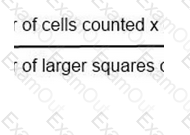
Cells/µL = 370 x 100 / 18 x 0.1
Cells/µL = 37000 / 1.8
Cells/µL = 20556 or 2.06 x 10⁴
A sample of cerebrospinal fluid is diluted 1:100; the standard 9 squares of a hemocytometer are counted on each side for a total of 18 large squares.
Side 1-- 186 nucleated cells counted
Side 2-- 184 nucleated cells counted
total nucleated cells = 370
Using the standard hemocytometer formula shown on the right, what is the nucleated cell count per microliter (µL)?
A negative glucose oxidase test and a positive test for reducing sugars in urine indicates the presence of a non-glucose reducing sugar such as galactose, fructose, glyceraldehyde, etc. This is the reason that certain patient populations require additional confirmatory sugar testing on their urine samples.
A negative glucose oxidase test and a positive test for reducing sugars in urine indicates: