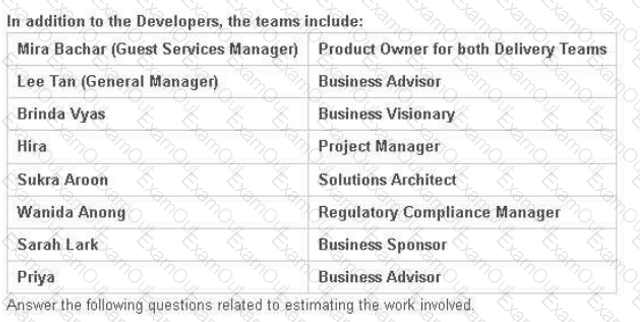
Towards the end of the Foundations phase of Project Increment 4, with the high-level requirements agreed, Hira, has asked the Developers to estimate the work required to deliver the Eco spa solution.
(The Developers have used the Planning Poker technique to generate their estimates. Hira now needs to determine how many Sprints will be required for the Delivery Teams to deliver the Eco-spa.
What should the Developers do to help Hira make this decision?)
Answer the following questions about the acceptance criteria within the project.
Decide whether the approach to setting and using acceptance criteria has been applied appropriately and select the response that supports your decision.
The requirement to ' install a heat reclamation system ' shows as a Should Have in the Prioritised Requirements List. During Investigation in Solution Development Timebox B, the Project Manager advised the team NOT to set detailed acceptance criteria for this requirement until later in the Timebox, since the requirement may have to be dropped and the work would be wasted.
Is this an appropriate action related to acceptance criteria?
The Timebox to deliver the online reservation system through the Hoy Hall website has experienced a major issue. During Timebox C a test was completed to
simulate an attack on the financial element of the online reservation system, with the intention of finding security weaknesses. It was found that it was
potentially possible to gain access to the system, its functionality and data. Further work is therefore needed to meet the information security elements of a
customer financial transaction.
Answer the following question about the actions to be taken by each role.
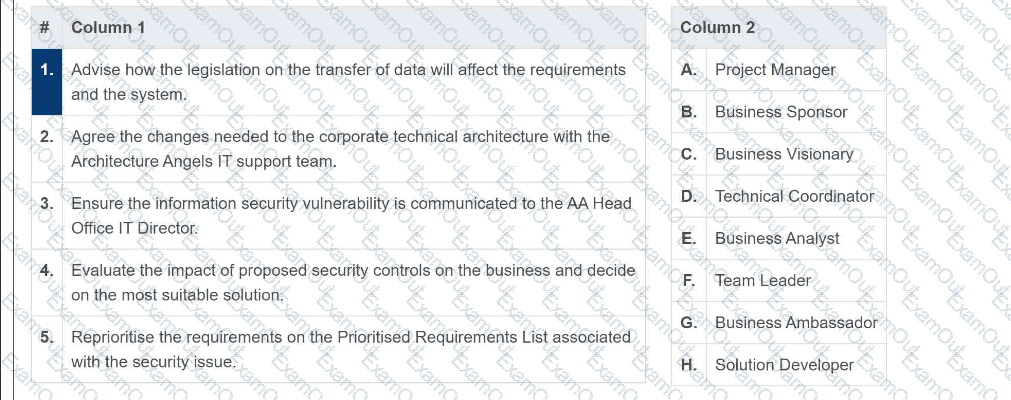
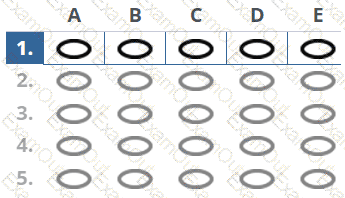
Column 1 describes a list of actions related to dealing with the security issue with the hotel reservation system. Column 2 lists the key roles. For each action in Column 1,
select from Column 2 the role that should carry out the action.
Each selection from Column 2 can be used once, more than once or not at all.
Column 1
Advise how the legislation on the transfer of data will affect the requirements
and the system.
Agree the changes needed to the corporate technical architecture with the
Architecture Angels IT support team.
Ensure the information security vulnerability is communicated to the AA Head
Office IT Director.
Evaluate the impact of proposed security controls on the business and decide
on the most suitable solution.
Reprioritise the requirements on the Prioritised Requirements List associated
with the security issue.
Column 2
Project Manager
Business Sponsor
Business Visionary
Technical Coordinator
Business Analyst
Team Leader
Business Ambassador
Solution Developer

During Refinement in Timebox B, a Review Session was scheduled for the Business Visionary to review the products completed during this Timebox, and to agree what
needed to be done before these would be acceptable.
Is this an appropriate application of Agile Project Management for this project?
Using the Project Scenario and the additional information provided for this question in the Scenario Booklet, answer the following questions about applying
controls to the end of Development Timebox C.
What action should the Project Manager take when considering the End of Timebox Review?
Answer the following questions about the acceptance criteria within the project.
Decide whether the approach to setting and using acceptance criteria has been applied appropriately and select the response that supports your decision.
The objective of Solution Development Timebox B is to ensure that the front and east wings are finished and approved. The Project Manager has pointed out that acceptance criteria for this part of the solution need to be agreed.
Is this an appropriate action related to acceptance criteria?
Answer the following questions about the acceptance criteria within the project.
Decide whether the approach to setting and using acceptance criteria has been applied appropriately and select the response that supports your decision.
During Solution Development Timebox A, a new Health and Safety requirement arises: the front door is required to have wheelchair access. This is a legal requirement and is a Must Have before any staff or general public access can be allowed. The Solution Development Team will work with the Local Planning Authority Officer, the specialist who identified the requirement, to identify further acceptance criteria for Solution Development Timebox A.
Is this an appropriate action related to acceptance criteria?
How should the lack of provision of a fire escape from the upstairs of the building in Timebox B initially be dealt with?
The Head Landscape Gardener liaised with several key stakeholders before changing the direction of the pathway around the grounds to ensure all of the new features in
the gardens could be enjoyed.
Which Agile principle MOST influences this course of action?
Which 2 statements explain why the Timber Tigers ' Site Manager would be an appropriate Solution Developer?