
Month End Sale Special - Limited Time 70% Discount Offer - Ends in 0d 00h 00m 00s - Coupon code: sntaclus

An Architect runs the following SQL query:
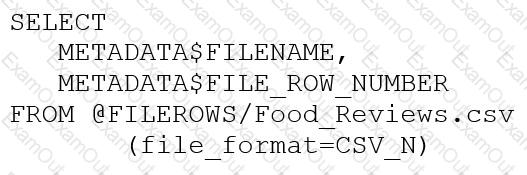
How can this query be interpreted?

A.

FILEROWS is a stage. FILE_ROW_NUMBER is line number in file.

B.

FILEROWS is the table. FILE_ROW_NUMBER is the line number in the table.

C.

FILEROWS is a file. FILE_ROW_NUMBER is the file format location.

D.

FILERONS is the file format location. FILE_ROW_NUMBER is a stage.

What is a characteristic of Role-Based Access Control (RBAC) as used in Snowflake?

A.

Privileges can be granted at the database level and can be inherited by all underlying objects.

B.

A user can use a "super-user" access along with securityadmin to bypass authorization checks and access all databases, schemas, and underlying objects.

C.

A user can create managed access schemas to support future grants and ensure only schema owners can grant privileges to other roles.

D.

A user can create managed access schemas to support current and future grants and ensure only object owners can grant privileges to other roles.

A user has the appropriate privilege to see unmasked data in a column.

If the user loads this column data into another column that does not have a masking policy, what will occur?

A.

Unmasked data will be loaded in the new column.

B.

Masked data will be loaded into the new column.

C.

Unmasked data will be loaded into the new column but only users with the appropriate privileges will be able to see the unmasked data.

D.

Unmasked data will be loaded into the new column and no users will be able to see the unmasked data.

Which data models can be used when modeling tables in a Snowflake environment? (Select THREE).

A.

Graph model

B.

Dimensional/Kimball

C.

Data lake

D.

lnmon/3NF

E.

Bayesian hierarchical model

F.

Data vault

What does a Snowflake Architect need to consider when implementing a Snowflake Connector for Kafka?

A.

Every Kafka message is in JSON or Avro format.

B.

The default retention time for Kafka topics is 14 days.

C.

The Kafka connector supports key pair authentication, OAUTH. and basic authentication (for example, username and password).

D.

The Kafka connector will create one table and one pipe to ingest data for each topic. If the connector cannot create the table or the pipe it will result in an exception.

An Architect needs to allow a user to create a database from an inbound share.

To meet this requirement, the user’s role must have which privileges? (Choose two.)

A.

IMPORT SHARE;

B.

IMPORT PRIVILEGES;

C.

CREATE DATABASE;

D.

CREATE SHARE;

E.

IMPORT DATABASE;

When using the Snowflake Connector for Kafka, what data formats are supported for the messages? (Choose two.)

A.

CSV

B.

XML

C.

Avro

D.

JSON

E.

Parquet

How can the Snowpipe REST API be used to keep a log of data load history?

A.

Call insertReport every 20 minutes, fetching the last 10,000 entries.

B.

Call loadHistoryScan every minute for the maximum time range.

C.

Call insertReport every 8 minutes for a 10-minute time range.

D.

Call loadHistoryScan every 10 minutes for a 15-minutes range.

A company needs to share its product catalog data with one of its partners. The product catalog data is stored in two database tables: product_category, and product_details. Both tables can be joined by the product_id column. Data access should be governed, and only the partner should have access to the records.

The partner is not a Snowflake customer. The partner uses Amazon S3 for cloud storage.

Which design will be the MOST cost-effective and secure, while using the required Snowflake features?

A.

Use Secure Data Sharing with an S3 bucket as a destination.

B.

Publish product_category and product_details data sets on the Snowflake Marketplace.

C.

Create a database user for the partner and give them access to the required data sets.

D.

Create a reader account for the partner and share the data sets as secure views.

What is a valid object hierarchy when building a Snowflake environment?

A.

Account --> Database --> Schema --> Warehouse

B.

Organization --> Account --> Database --> Schema --> Stage

C.

Account --> Schema > Table --> Stage

D.

Organization --> Account --> Stage --> Table --> View