
ORGANIZATION
Use the ‘Additional Information’ in the Scenario Booklet to answer this question.
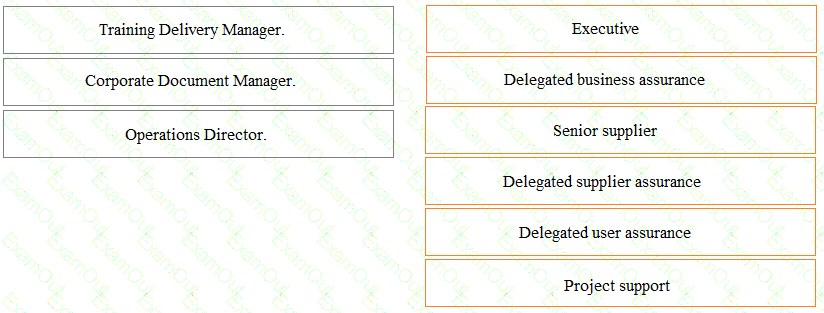
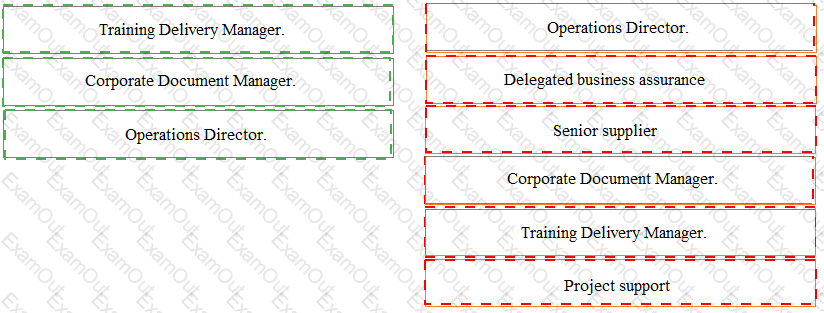
Here are three individuals who work for ABC Company.
Which project management team role (A-F) would be the most appropriate for each individual?
Choose only one role for each individual. Each role can be used ONCE, or not at all.
Scenario
A central government department, the Ministry of Food Hygiene (MFH), faces increasing pressure to cut costs, better manage suppliers’ performance and reduce the confusion caused by inadequate internal controls, outdated standards and outdated technology. External consultants were employed to conduct a feasibility study to identify options to address the problems, and the likely costs and benefits. The following options were considered:
● Do nothing.
● Re-engineer selected business functions.
● Outsource selected business functions.
The feasibility study concluded that there was a case for outsourcing the MFH Information Technology
Division and the Facilities Division (maintenance of buildings and grounds). The recommendations were:
● One service provider should be contracted to provide the services currently provided by the
Information Technology Division and the Facilities Division.
● A 10-year service contract should be agreed with the selected service provider.
The feasibility study developed high-level designs of the current organization, processes, systems and
operating models, plus an outline Business Case for the required project. The external consultants
also made the following recommendations for the management of the project:
● Use PRINCE2.
● Set up the project with 4 management stages:
Stage 1. Standard PRINCE2 initiation activities.
Stage 2. Create detailed designs (future organization, processes, systems and operating
models) and the service level agreement between MFH and the future service
provider.
Stage 3. Request and evaluate proposals, select service provider and agree contract.
Stage 4. Transfer equipment and staff, transfer responsibility for service provision and run
trial period.
Initial estimates indicated that the project would cost £2.5m and take two years to complete.
MFH senior management agreed that there was a case for outsourcing, and accepted the
recommendations as a basis for the project. There is an expected saving of £20m over 10 years.
The Outsourcing project has completed the Starting up a Project process and is now in the initiation stage. Because of the strategic importance of the project, the MFH Chief Executive Officer has taken the role of Executive. A PRINCE2-experienced Project Manager has been appointed from within MFH. Staff within the business functions being outsourced will work with the external consultants who conducted the feasibility study to define the detailed designs.
Which 2 statements should be recorded under the Reasons heading?
The project is in stage 3. Zero time tolerance has been given for this stage. When checking progress, the project manager noticed that the checkpoint report from the external supplier of the 'e-learning course' is late. As work package progress information is missing, the project manager has decided to raise an exception report.
Is this an appropriate action, and why?
Project Scenario – Health and Safety Training Project:
ABC Company is a well-established training company that uses a standard model to develop training materials and deliver courses to customers.
ABC Company has commissioned a project in response to recent changes in government legislation relating to health and safety on construction sites. The project will deliver “capability to provide health and safety training”, including the materials needed for classroom-based training and e-learning. The expected benefits for construction companies include a reduction in lost days and legal costs due to accidents.
The e-learning course will be developed by a specialist external consultancy. The materials for classroom-based training will be delivered by ABC Company’s development team. All course materials will be piloted before they are used. ABC Company will deliver training to its customers and also hopes to sell the course materials to other training companies as part of their operational business. ABC Company will use their own sales and marketing departments to promote the courses.
The legislation requires construction companies to comply with the new legislation within two years. The course materials and trainers have to be accredited by a government agency before courses can be delivered. ABC Company is planning to deliver pilot courses within five months of starting the project.
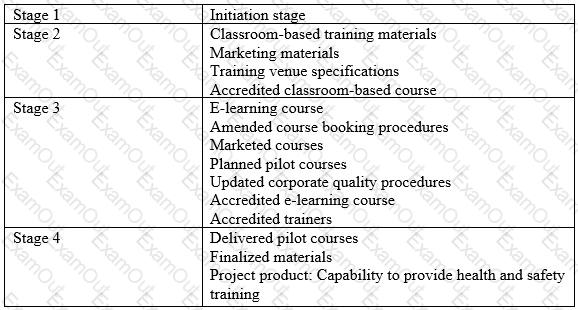
The ABC Company standard development model for new courses recommends the following stages:
End of the Project scenario.
Additional Information:
The Chief Executive Officer (CEO) founded the company five years ago. Under her leadership, ABC Company has grown quickly into a successful training company. It delivers a range of accredited professional training.
The Finance Director is also a founder member of ABC Company and is responsible for authorizing budgets for the Operations and Development Teams. She authorizes all large contracts personally.
The Purchasing Manager reports to the Finance Director and is responsible for managing and monitoring supplier contracts.
The Operations Director is responsible for the delivery off all training and for the training development budget. His department organizes courses, venues and trainers. They work with the Product and the Sales teams to provide a comprehensive training schedule. ABC Company’s IT manager reports to the Operations Director.
The Business Development Director has recently been appointed to identify new training needs and propose new products. She will work with the Operations. Director to ensure a cost-conscious approach and that appropriate development technologies are used for the health and safety course.
The Training Development Manager reports to the Business Development Director and is responsible for developing training materials and gaining accreditation, in accordance with the standard course development model. Course developers in his team have skills in a range of development technologies and are allocated to projects as needed.
The Training Delivery Manager, who reports to the Operations Director, is responsible for ensuring that internal and external trainers deliver ABC Company training courses to the required standard. He also checks course materials to ensure they are fit for purpose and of the required quality.
The Central Services Director has responsibility for corporate communications, facilities management and configuration management. He recently led a project to consolidate all company quality systems into one quality management system and set up a corporate quality department, now managed by the Corporate Quality Manager.
The Corporate Document Manager reports to the Central Services Director. She helped establish the company’s document management system and now operates it across the business. She manages a team of administrators and contracts staff when workload is high.
The Sales Director joined ABC Company two months ago and is keen to establish himself by suggesting new markets for the courses and material. All account managers and the marketing team report to him. They promote existing training courses to other training companies and existing customers.
End of the additional information.
ABC Company produces a corporate business plan which includes the targets for the next 12 months. For the Health and Safety Training Project, a feasibility study was carried out and, as a result, the expected sales were included in this plan. During the 'starting up a project' process, the executive advised the project manager that the corporate business plan provides sufficient justification to initiate the project.
Is this a correct application of the 'continued business justification' principle, and why?
Which of the following activities is NOT an action of preparing for planned closure?
Which of the following statements is FALSE regarding the Continued Business Justification?
The Calendar project was delivered as originally planned, and Is now preparing for planned closure.
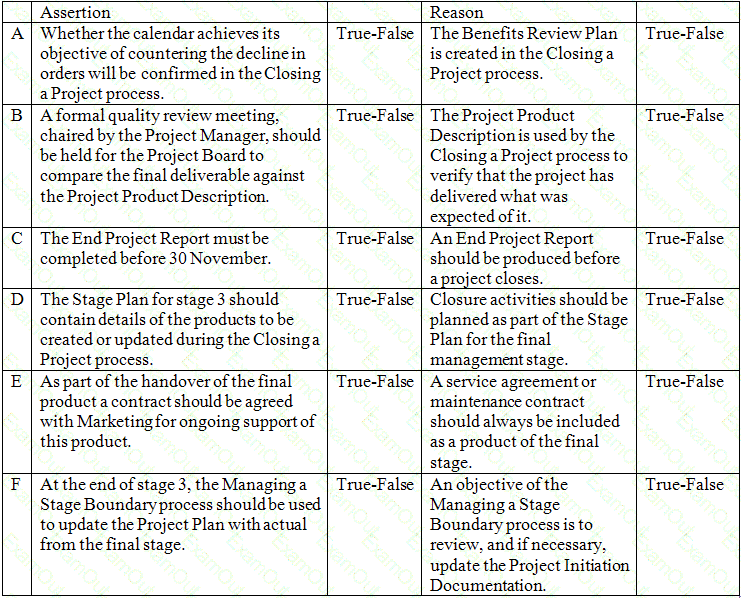
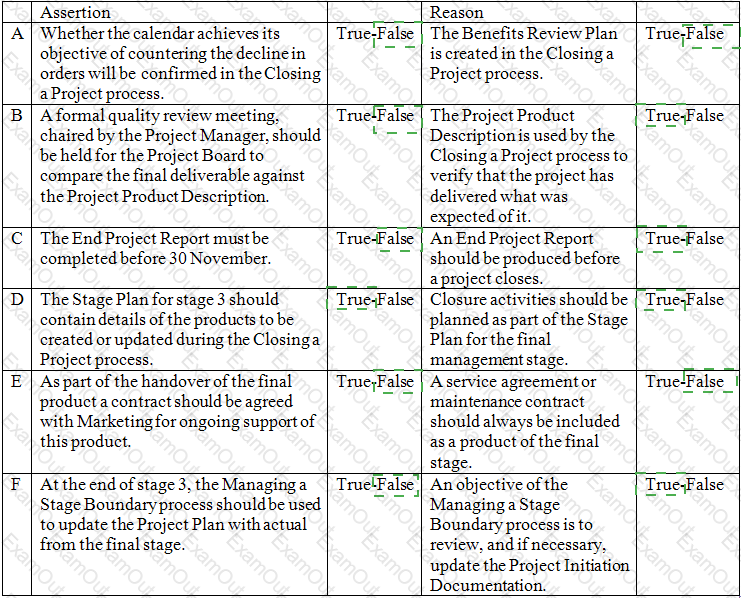
Lines 1 to 6 in the table below consist of an assertion statement and a reason statement. For each line identify the appropriate option, from options A to E, that applies. Each option can be used once, more than once or not at all.
When updating the project plan as part of Managing a stage boundary, what else might be updated?
The work package to produce the 'updated corporate quality procedures' was created during stage 3. Before accepting the work package, the team manager produces the team plan and finds that the expected delivery date is unrealistic. As a result, the project manager agrees an extra two weeks to complete the work package, within the current stage tolerance. The work package is then accepted by the team manager.
Is this an appropriate application of the 'manage product delivery' process, and why?
The project is in stage 3. The BuildyBrick construction teams are unsure about using the required environmentally friendly concrete technique. As the team has not used the technique before, the work could take longer than originally planned. The Regeneration Manager has arranged a visit to another site where the technique is being used.
Which principle is being applied, and why?
