
Spring Sale Special - Limited Time 70% Discount Offer - Ends in 0d 00h 00m 00s - Coupon code: sntaclus

Which of the following describes hyperextension of a body part at a joint?

A.

The lateral movement away from the middle of the body (midline) in the frontal plane.

B.

The posterior movement away from the anatomical position in the sagittal plane.

C.

The anterior movement away from the anatomical position in the sagittal plane.

D.

The posterior movement back to the anatomical position in the sagittal plane.

The four main types of macromolecules found in our cells are lipids, carbohydrates, proteins, and

A.

fatty acids.

B.

unsaturated fats.

C.

phospholipids.

D.

nucleic acids.

Which statement best explains why a child may resemble one parent more than the other?

A.

The genes of the dominant parent are expressed more vigorously.

B.

Older genetic material is weaker.

C.

One set of genes had more dominant characteristics.

D.

Larger eggs contain more genetic material.

Review the diagram below showing several stages in the human reproductive cycle.
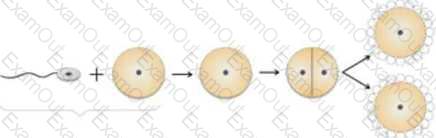
In which of these structures does the process represented by stage A normally occur?

A.

Uterus

B.

Vagina

C.

Ovary

D.

Fallopian tube

Veins throughout the body contain structures, indicated by arrows, in the image below.

The structures shown in the image prevent which of the following from occurring?

A.

Forward flow of blood

B.

Obstruction of blood flow

C.

Backflow of blood

D.

Blood leaking into the interstitial spaces

The thymus, lymph nodes, and spleen are all organs of which system?

A.

Immune

B.

Endocrine

C.

Cardiovascular

D.

Integumentary

In the human male, which of these structures produces sperm cells?

A.

Cowper's glands

B.

Prostate gland

C.

Testes

D.

Epididymis

The light-sensitive cells of the eye are called rods and cones. In which of these layers of the eye are they found?

A.

Sclera

B.

Retina

C.

Choroid

D.

Cornea

What is the term used to describe random changes in DNA, which may be silent, negative, or positive, to the organism in which they occur?

A.

Recombination

B.

Mutation

C.

Duplication

D.

Replication

On Isle Royale, the natural predator of the moose is the wolf. In 1970, the moose population on Isle Royale was almost double that of wolves. By 1980, the moose population had been reduced to half that of 1970, while the number of wolves had almost tripled.

Which of the following statements best explains these events?

A.

As the wolf population grew in size, the moose population was being driven down by increased predation.

B.

Disease had eliminated much of the moose population and wolves thrived due to less competition with moose for resources.

C.

Hunting from 1970 to 1980 eliminated much of the moose population and made room for more wolves.

D.

Wolves breed more than moose and therefore were able to increase their numbers more rapidly.