Summer Sale Special - Limited Time 70% Discount Offer - Ends in 0d 00h 00m 00s - Coupon code: sntaclus

You have an on-premises server named Served that runs Windows Server. You have an Azure subscription. You plan to back up the files and folders on Server1 to Azure by using Azure Backup. You need to define how long the backups will be retained. What should you use to configure the retention?

A.

Backup center

B.

Windows Server Backup

C.

the Microsoft Azure Recovery Services (MARS) agent

D.

a Recovery Services vault

The Default Domain Policy Group Policy Object ( GPO) is shown in the GPO exhibit. (Click the GPO tab.)

The members of a group named Service Accounts are shown in the Group exhibit. (Click the Group tab.)

An organizational unit (OU) named ServiceAccounts is shown in the OU exhibit. (Click the OU tab.)

You create a Password Settings Object (PSO) as shown in the PSO exhibit. (Click the PSO tab.)

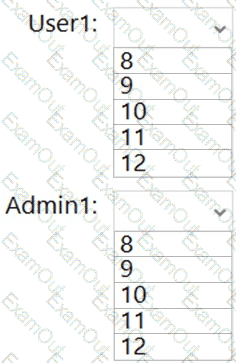
For each of the following statements, select Yes if the statement is true. Otherwise, select No.

NOTE: Each correct selection is worth one point.

You have a server named Server1 that runs Windows Server and is hosted in a VMWare environment. Server1 contains an ASP.NET application named Appl. Users access App1 by using the following URL: https://app1.contoso.com.

You need to use the integrated flow in Azure Migrate to migrate App1 to Azure App Service. After the migration, users must be able to access App1 by using the same URL.

Which three actions should you perform in sequence? To answer, move the appropriate actions from the list of actions to the answer area and arrange them in the correct order.

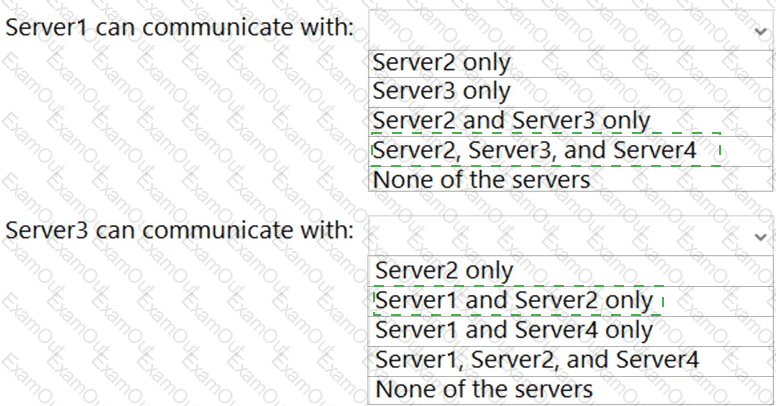
The servers run Windows Server and have the network configurations shown in the following table.

Server3 is configured as a NAT gateway. All the servers allow ICMP requests.

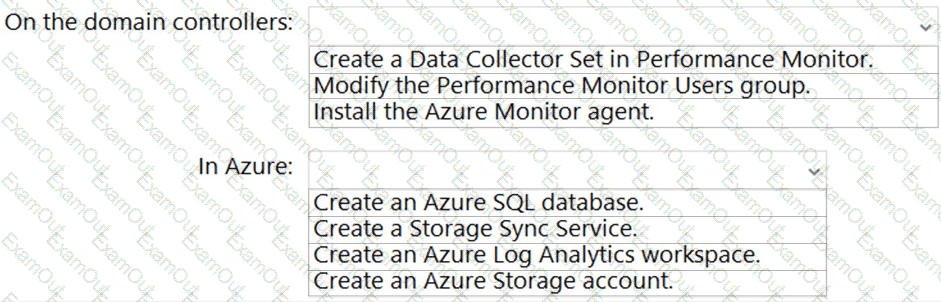
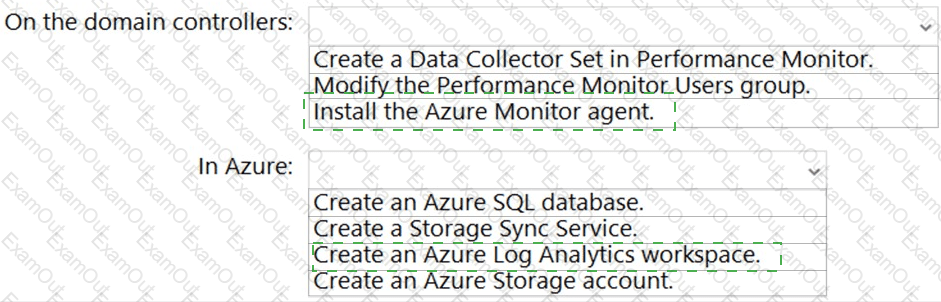
Use the drop-down menus to select the answer choice that completes each statement based on the information presented in the graphic.

NOTE: Each correct selection is worth one point.

You deploy Azure Migrate to an on-premises network.

You have an on-premises physical server named Server1 that runs Windows Server and has the following configuration.

* Operating system disk 600 GB

* Data disic 3 TB

* NIC Teaming: Enabled

* Mobility service: installed

* Windows Firewall: Enabled

* Microsoft Defender Antivirus: Enabled

You need to ensure that you can use Azure Migrate to migrate Server1.

Solution: You disable NIC Teaming on Server1.

Does this meet the goal?

A.

Yes

B.

No

Your on-premises network contains an Active Directory Domain Services (AD DS) domain. The domain contains a server named Server1 that runs Windows Server and is in an organizational unit (OU) named OU1.

You have a Group Policy Object (GPO) that is linked to OUT and has the Windows Defender SmartScreen settings shown in the following table.

You have the apps shown in the following table.

Which apps can you install on Served?

A.

App1 only

B.

App1 and App2 only

C.

App1 and App3 only

D.

App1, App2, and App3

You need to use a comma-separated value (CSV) file to import server inventory to Azure Migrate. Which fields are mandatory for each entry in the CSV file?

A.

Server name. Cores, OS Name, and Memory (in MB)

B.

Server name, IP addresses. Disk 1 size (in GB), and CPU utilization percentage

C.

Server name, IP addresses, OS version, and Number of disks

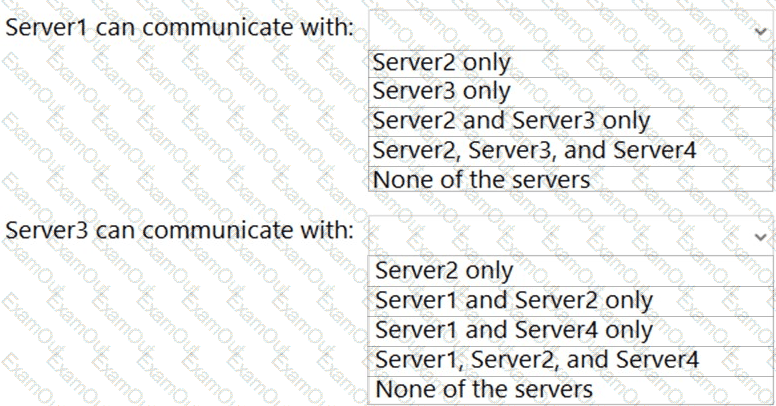
Your on-premises network contains an Active Directory Domain Services (AD DS) domain.

The domain contains four servers named Server1, Server2. Server3. and Server4 that run Windows Server.

You configure the connection security rules shown in the following table.

Server4 does NOT have any connection security rules applied.

With which servers can Server1 and Server2 establish communication after the connection security rules are applied? To answer, select the appropriate options in the answer area.

NOTE: Each correct selection is worth one point.
You manage 200 physical servers that run Window s Server.

You plan to migrate the servers to Azure.

You need to prepare for discovery of the servers by using Azure Migrate.

Which three actions should you perform in sequence on a physical server? To answer, move the appropriate actions from the list o f actions to the answer area and arrange them in the correct order.

You have a server named Server1 that runs Windows Server.

You need to ensure that only specific applications can modify the data in protected folders on Server1.

Solution: From App & browser control, you configure the Reputation-based protection.

Does this meet the goal?

A.

Yes

B.

No