Summer Sale Special - Limited Time 70% Discount Offer - Ends in 0d 00h 00m 00s - Coupon code: sntaclus

What is the primary role of the Vault Security Operator (VSO) in a Kubernetes environment?

A.

Managing Vault server deployments and auto-scaling Vault instances in Kubernetes

B.

Enforcing Kubernetes network policies for Vault communication

C.

Automating the injection and lifecycle management of Vault secrets for Kubernetes workloads

D.

Replacing Kubernetes Secrets with a built-in alternative that does not require Vault

You have a new team member on the Vault operations team. Their first task is to rotate the encryption key in Vault as part of the organization’s security policy. However, when they log in, they get an access denied error when attempting to rotate the key. The policy being used is below. Why can’t the user rotate the encryption key?

path " auth/* " {

capabilities = [ " create " , " read " , " update " , " delete " , " list " ]

}

path " sys/rotate " {

capabilities = [ " read " , " update " ]

}

A.

The policy requires sudo privileges since it is a root-protected path

B.

The policy doesn’t include create privileges so a new encryption key can’t be created

C.

The policy should include sys/rotate/ < name of key > as part of the path

D.

The encryption key has a minimum TTL, therefore the key cannot be rotated until that time expires

Which Vault secret engine may be used to build your own internal certificate authority?

A.

Transit

B.

PKI

C.

PostgreSQL

D.

Generic

Which of these is not a benefit of dynamic secrets?

A.

Supports systems which do not natively provide a method of expiring credentials

B.

Minimizes damage of credentials leaking

C.

Ensures that administrators can see every password used

D.

Replaces cumbersome password rotation tools and practices

What artifacts allow you to regenerate a root token after you have revoked it?

Pick the 2 correct responses below.

A.

Access to the OS root user.

B.

Policy with sudo access.

C.

Initial root token.

D.

Unseal keys.

E.

Recovery keys.

Which of the following are true about Vault policies?

Pick the 2 correct responses below.

A.

A Vault policy must be created for every secret that will be accessed.

B.

Vault supports an extensible permission structure that allows new permission types to be added as plugins.

C.

Vault policies support wildcards anywhere in the path.

D.

Vault policies support regular expressions.

E.

Vault policies support globbing wildcards using the * symbol only at the end of the path.

F.

Vault policies are path-based.

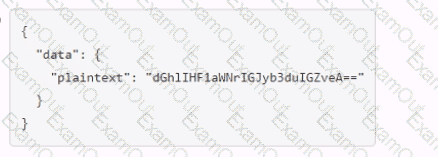
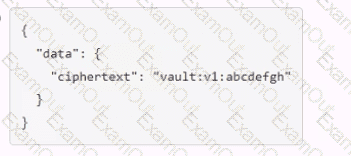
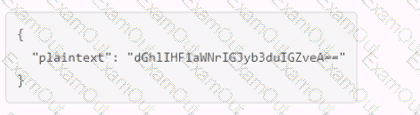
A user issues the following cURL command to encrypt data using the transit engine and the Vault AP:

Which payload.json file has the correct contents?
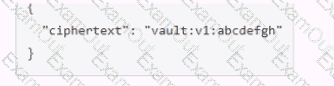
A.

B.

C.

D.

When using Integrated Storage, which of the following should you do to recover from possible data loss?

A.

Failover to a standby node

B.

Use snapshot

C.

Use audit logs

D.

Use server logs

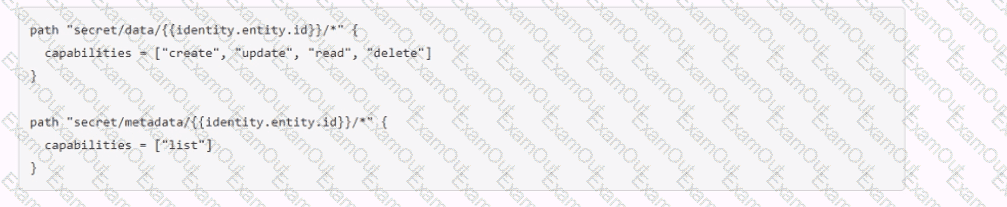
What does the following policy do?

A.

Grants access for each user to a KV folder which shares their id

B.

Grants access to a special system entity folder

C.

Allows a user to read data about the secret endpoint identity

D.

Nothing, this is not a valid policy

How many Shamir ' s key shares are required to unseal a Vault instance?

A.

All key shares

B.

A quorum of key shares

C.

One or more keys

D.

The threshold number of key shares