
A German automotive manufacturer expands its EV line to comply with tightening emission regulations in key European markets. The firm conducts transition risk scenario analysis to evaluate financial and operational exposure to policy changes, carbon pricing, and market shifts. Which transition risk input did the firm most likely use while conducting the scenario analysis?
An international hotel chain reviews progress on sustainability goals in preparation for an Earth Day marketing campaign. A sustainability director suggests the hotel highlight how its energy and food sustainability initiatives align with UN SDG targets.
Which of the following correctly describes an SDG target that the hotel could align with?
A global investment bank expands its risk department to include climate risk assessment. Senior management directs the department to implement approaches for evaluating how climate change affects traditional risk types. A risk manager recommends risk metrics for key risk types that measure physical and transition risk impacts.
To measure credit risk, which metric should the analyst recommend?
As climate change poses new financial risks to a central bank’s monetary policy operations, the bank decides to adapt operations with NGFS guidelines. Because the central bank does not include climate change in supervision practices, the bank consults subject matter experts (SMEs) to develop a proposal for central bank action on climate change. After completing the risk assessment, SMEs recommend the bank incorporate microprudential and macroprudential measures to embed climate change into supervision practices.
Which action are SMEs likely to recommend?
A federal regulator analyzes how the increasing frequency of natural disasters may impact the banking sector. The regulator reviews and evaluates the potential for widespread climate events to simultaneously affect multiple financial institutions and drive cascading economic disruptions. What risk type is the regulator most likely evaluating?
Leaders of a small island nation implement a sector-specific carbon reduction policy to address climate change. The policy includes a commitment to reduce country emissions through NDCs under the Paris Agreement. Which of the following emission reduction policies is the nation most likely implementing?
A large insurance company in South America expands use of climate scenario analysis. The company used RCPs in previous scenario analyses but now hires an actuary with climate expertise to incorporate SSPs in this process.
How can the actuary advise the insurance company use SSPs going forward?
Senior management of a sportswear manufacturer will issue a bond to optimize company capital structure, while providing investors with an opportunity to contribute to positive transformation of the fashion industry. Management prefers a bond with a high rate of issuance, and the company sustainability team researches various green and sustainable finance instruments and issuance information over the past 5 years. The team recommends a bond that globally posted the highest growth in issuance between 2019 and 2020.
Which bond did the team recommend?
Alimento Y Agricultura (AYA) is a food and agriculture conglomerate headquartered in Costa Rica with operations throughout Central America. AYA historically produced coffee, bananas, and sugar. Over the last decade, the company growing region experienced climate-related crop production challenges. The region suffered prolonged drought conditions and severe flooding events. AYA leadership may relocate existing coffee farm locations in response to these climate stressors.
Last year Costa Rica introduced mandatory climate risk reporting aligned with ISSB standards The government mandate compelled AYA to enhance its transition and physical risk assessment across the company. A newly formed sustainability governance team prioritizes the following objectives:
• Update TCFD reporting with new ISSB IFRS S2 requirements
• Initiate more comprehensive scenario analysis
• Conduct nature and water risk assessments
AYA previously reported climate risks aligned with all TCFD pillars, risk categories, and scenario analysis recommendations. Reporting includes all Scope 1 and Scope 2 emissions, reduction targets, and appointments of board officers responsible for climate risks. Scenario analysis is used to assess all banana, coffee, and sugar production climate risk exposure.
AYA uses 2°C and 4°C climate scenarios to assess company impacts from physical and transition risk. Under the 2°C scenario transition risk increases, while under the 4°C scenario water risk significantly increases.
AYA appoints an SCR certificate holder to the position of nature risk manager to advance nature-based assessments. The manager contracts with a nature risk consultancy to better understand and manage exposure to nature-related risks and impacts. The consultancy identifies crop production, water quality, and water quantity as the primary nature-based risks.
The consultancy produces the following graph to demonstrate coffee crop productivity:
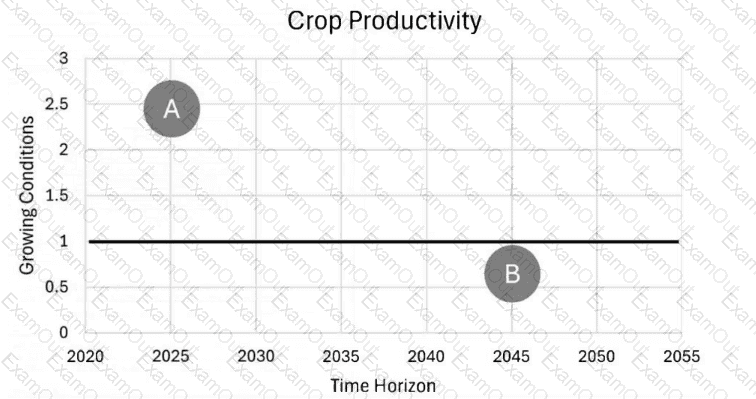
If growing conditions fall below 1, it is not economical for AYA to continue coffee production in the region. Point A indicates current growing conditions. Point B is a forecast of future conditions under a 4°C scenario, created by the consultancy model.
After identifying nature risks broadly, AYA performs a water risk assessment (WRA). The WRA assesses historical and future water withdrawal rates and identifies operational water dependencies.
Following the WRA, the company engages with existing stakeholders to adapt existing business strategy. AYA initiates a pilot project with upstream farmers to protect their land. AYA will either train or pay local farmers to plant shrubbery and buffer zones to reduce erosion and runoff of sediments, nutrients, and pathogens from local crop production and industry.
Which LEAP concept best describes Point A in the context of coffee growing conditions?
A team of climate risk specialists at a global non-profit research organization prepares a study on climate policy and achieving national climate change mitigation targets. The study focuses on actors, non-state and subnational (NSA) participants, and actions that can be taken to impact climate policy.
How should the team describe effective climate policy and climate change mitigation targets?
