Halloween Sale Special - 75% Discount Offer - Ends in 0d 00h 00m 00s - Coupon code: estly75

You added three new applications to FortiEDR using only the Path attribute. What are two expected outcomes of this configuration? (Choose two answers)

A.

These applications will be disabled until explicitly enabled.

B.

Only applications in the specified directory paths will be blocked.

C.

These applications will be blocked only if the file name also matches.

D.

All instances of these applications will be blocked, regardless of location.

You discovered that a newly installed collector does not display on the Inventory tab in the central manager. Which two troubleshooting steps must you perform? (Choose two answers)

A.

Verify that the central manager can resolve the collector hostname through DNS.

B.

Verify that TCP ports 8081 and 555 are open between the collector and the central manager.

C.

Check whether the FortiEDR services are running on the collector device.

D.

Export and review the collector logs from the Central Manager for connection errors.

A playbook is configured with two actions: terminate process and isolate device. The terminate process action fails because the process is protected by Windows. What is the expected behavior for the second action, isolate device? (Choose one answer)

A.

The playbook execution pauses and requires administrator intervention.

B.

The playbook generates a notification email and execution stops.

C.

The playbook execution stops because the action fails.

D.

The playbook continues and executes the second action.

Refer to the exhibit.

question 4

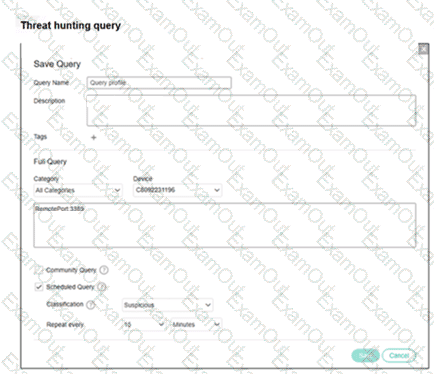
Based on the exhibit, which statement about this threat hunting query is true? (Choose one answer)

A.

A security incident will be generated whenever the device attempts an RDP connection.

B.

The query is limited to detecting network activity and does not inspect process behavior.

C.

The query is configured as a global hunting rule and is automatically visible across all organizations.

D.

RDP connections will be automatically blocked and classified as suspicious.

Refer to the exhibit.

question 5

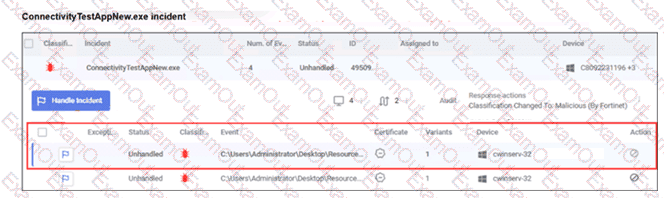
What observation can you make about the ConnectivityTestAppNew.exe incident? (Choose one answer)

A.

A rule assigned action is set to block but the policy is in simulation mode.

B.

The incident has not been handled by a console administrator.

C.

The incident was archived from the console unhandled.

D.

The incident was handled automatically by the communication control policy.

Refer to the Exhibit:

question 6

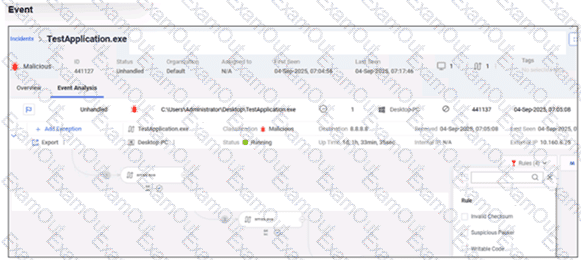
Based on the incident details shown in the exhibit, which two statements about this incident are true? (Choose two answers)

A.

The destination IP address is blocked by FortiGate.

B.

The incident occurred on only one device.

C.

The incident is classified by the FortiEDR Core.

D.

The incident has already been fully handled.

What action does an on-premises reputation server take when it receives a hash request that is not found in its local database? (Choose one answer)

A.

Ignores them until manually updated

B.

Stores them locally and waits for endpoint input

C.

Requests the missing hashes from the cloud reputation service

D.

Automatically blocks applications with unknown hashes

Refer to the exhibit:

question 8

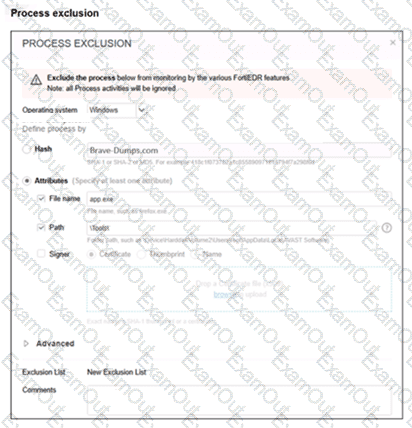
You configured an execution prevention exclusion with both File Name = app.exe and Path = C:\Tools. What will FortiEDR do? (Choose one answer)

A.

Exclude only signed versions of app.exe.

B.

Exclude only app.exe when it is running from C:\Tools.

C.

Exclude app.exe whenever it appears.

D.

Exclude all files in C:\Tools.

Refer to the exhibit.

question 9

Based on the event shown in the exhibit, which two statements about the event are true? (Choose two answers)

A.

The event is marked as Handled.

B.

FCS classified the event as malicious.

C.

The user was able to launch TestApplication.exe.

D.

TestApplication.exe is sophisticated malware.

Refer to the Exhibit:

question 10

Based on the FortiEDR status output shown in the exhibit, what are two reasons for the degraded state? (Choose two answers)

A.

The endpoint has windows firewall enabled.

B.

The collector is installed with an incorrect registration password.

C.

The collector is installed with an incorrect port number.

D.

The endpoint cannot reach the central manager.