A developer has created a repository in AWS CodeArtifact . The development team needs to receive notifications when new packages are published to the repository.
Which solution will meet this requirement with the LEAST operational overhead ?
A developer is writing an application that will retrieve sensitive data from a third-party system. The application will format the data into a PDF file. The PDF file could be more than 1 MB. The application will encrypt the data to disk by using AWS Key Management Service (AWS KMS). The application will decrypt the file when a user requests to download it. The retrieval and formatting portions of the application are complete.
The developer needs to use the GenerateDataKey API to encrypt the PDF file so that the PDF file can be decrypted later. The developer needs to use an AWS KMS symmetric customer managed key for encryption.
Which solutions will meet these requirements?
A company’s website runs on an Amazon EC2 instance and uses Auto Scaling to scale the environment during peak times. Website users across the world ate experiencing high latency flue lo sialic content on theEC2 instance. even during non-peak hours.
When companion of steps mill resolves the latency issue? (Select TWO)
A developer is creating an application that includes an Amazon API Gateway REST API in the us-east-2 Region. The developer wants to use Amazon CloudFront and a custom domain name for the API. The developer has acquired an SSL/TLS certificate for the domain from a third-party provider.
How should the developer configure the custom domain for the application?
An ecommerce company is developing a serverless application to track user activities. The company needs to track each type of activity with a timestamp and a unique product ID. The company also must track actions that are associated with each activity, such as product views, shopping cart actions, purchases, and checkout processes.
The company is planning a marketing campaign based on each user ' s activity. A developer needs to implement a partitioning strategy for an Amazon DynamoDB table to meet the data storage and access requirements for the application. The strategy must maximize provisioned throughput efficiency while minimizing the risk of throttling.
Which solution will meet these requirements?
A company has built an AWS Lambda function to convert large image files into output files that can be used in a third-party viewer application The company recently added a new module to the function to improve the output of the generated files However, the new module has increased the bundle size and has increased the time that is needed to deploy changes to the function code.
How can a developer increase the speed of the Lambda function deployment?
A developer is designing a serverless application with two AWS Lambda functions to process photos. One Lambda function stores objects in an Amazon S3 bucket and stores the associated metadata in an Amazon DynamoDB table. The other Lambda function fetches the objects from the S3 bucket by using the metadata from the DynamoDB table. Both Lambda functions use the same Python library to perform complex computations and are approaching the quota for the maximum size of zipped deployment packages.
What should the developer do to reduce the size of the Lambda deployment packages with the LEAST operational overhead?
A company needs to deploy all its cloud resources by using AWS CloudFormation templates A developer must create an Amazon Simple Notification Service (Amazon SNS) automatic notification to help enforce this rule. The developer creates an SNS topic and subscribes the email address of the company ' s security team to the SNS topic.
The security team must receive a notification immediately if an 1AM role is created without the use of CloudFormation.
Which solution will meet this requirement?
A company uses AWS Secrets Manager to store API keys for external REST services. The company uses an AWS Lambda function to rotate the API keys on a regular schedule.
Due to an error in the Lambda function, the API keys are successfully updated in AWS Secrets Manager but are not updated in the external REST services. Before investigating the root cause of the issue, the company wants to resume requests to the external REST services as quickly as possible.
Which solution will meet this requirement with the LEAST operational overhead ?
A company has point-of-sale devices across thousands of retail shops that synchronize sales transactions with a centralized system. The system includes an Amazon API Gateway API that exposes an AWS Lambda function. The Lambda function processes the transactions and stores the transactions in Amazon RDS for MySQL. The number of transactions increases rapidly during the day and is near zero at night.
How can a developer increase the elasticity of the system MOST cost-effectively?
A developer is working on a Python application that runs on Amazon EC2 instances. The developer wants to enable tracing of application requests to debug performance issues in the code.
Which combination of actions should the developer take to achieve this goal? (Select TWO)
A developer is working on a web application that requires selective activation of features . Features must remain hidden from end users until they are ready for release.
Which solution will meet these requirements?
A developer has a financial application. The application uses AWS Secrets Manager to manage an Amazon RDS for PostgreSQL database ' s username and password. The developer needs to rotate the password while maintaining the application ' s high availability. Which solution will meet these requirements with LEAST development effort?
A developer is troubleshooting an application mat uses Amazon DynamoDB in the uswest-2 Region. The application is deployed to an Amazon EC2 instance. The application requires read-only permissions to a table that is named Cars The EC2 instance has an attached IAM role that contains the following IAM policy.
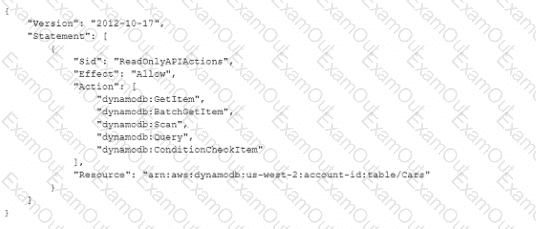
When the application tries to read from the Cars table, an Access Denied error occurs.
How can the developer resolve this error?
A developer received the following error message during an AWS CloudFormation deployment:
Which action should the developer take to resolve this error?